Table of Contents
- Why Private Label Cotton Swabs on Amazon FBA?
- Market Analysis: Cotton Swab Opportunity on Amazon in 2026
- Choose Your Cotton Swab Product Niche
- Source Your Private Label Cotton Swabs
- Design Your Brand and Packaging
- Calculate Your Amazon FBA Profit Margins
- Create a High-Converting Amazon Listing
- Launch Strategy and PPC Advertising
- Scale Your Cotton Swab Brand Beyond Launch
- Frequently Asked Questions
Starting a private label cotton swab brand typically requires a modest initial investment and takes 8–12 weeks from sourcing to first sale. The Amazon FBA cotton swabs category represents a $200M+ annual market in the US alone, with eco-friendly bamboo variants growing at 40%+ year-over-year — creating significant white space for new private label brands that differentiate on sustainability, quality, and packaging design.
This guide walks you through every step of building a profitable cotton buds private label business on Amazon, from product selection and manufacturer sourcing to listing optimization and scaling strategies. Every recommendation is grounded in real manufacturing economics and current 2026 fee structures.
As a cotton swab manufacturer with 23 years of experience supplying Amazon FBA cotton swabs to sellers worldwide, SwabMasters has helped launch over 200 private label brands across multiple marketplaces. This guide distills that experience into an actionable playbook.
Why Sell Private Label Cotton Swabs on Amazon?
Private label cotton swabs offer 25–35% net margins — significantly above the Amazon platform average of 15–20% for consumable products. Cotton swabs on Amazon combine several characteristics that make them ideal for private label sellers: they are lightweight (low fulfillment fees), consumable (high repeat purchase rate), and allow meaningful differentiation through materials and eco-positioning.
The opportunity to sell private label cotton swabs on Amazon is driven by three structural advantages that new sellers can exploit immediately. Understanding the cotton swab profit margin potential is essential before committing capital.
Advantage 1: Low barrier to entry with high repeat purchase. Unlike electronics or fashion, cotton swabs require no complex R&D, no size variations, and no seasonal inventory risk. A customer who buys your 500-count pack will reorder every 2–3 months, creating predictable revenue without ongoing acquisition costs. Amazon’s Subscribe & Save program amplifies this effect — over 35% of purchases in this category are subscription orders.
Advantage 2: The eco-premium opportunity. Bamboo and paper-stick cotton swabs command a 100–200% retail price premium over standard plastic-stick products on Amazon, while manufacturing costs increase only 30–50%. This margin gap is where private label sellers thrive. Consumers actively seek eco-friendly alternatives and are willing to pay more for them, especially in the Beauty & Personal Care category where brand values influence purchasing decisions.
Advantage 3: Category leader vulnerability. Q-tips dominates the market by brand recognition, but their Amazon listings are optimized for wholesale distribution, not direct-to-consumer storytelling. Their packaging is generic, their A+ Content is minimal, and they compete primarily on price. A well-positioned cotton buds private label brand with superior packaging, compelling brand narrative, and targeted PPC can capture meaningful market share in specific sub-niches (bamboo, organic, cosmetic-specific).
SwabMasters Insight: Of the 200+ private label brands we have supplied for Amazon FBA, those focusing on eco-friendly bamboo variants achieve 30%+ higher margins than those selling standard plastic-stick products — primarily because the retail price premium (2x) far exceeds the manufacturing cost increase (1.3–1.5x). Contact us for Amazon FBA-specific pricing →
Market Analysis: Cotton Swab Opportunity on Amazon in 2026
The Amazon cotton swabs category generates over $200 million in annual US revenue across 900+ active products, with private label sellers capturing an increasing share from legacy incumbents. Understanding the competitive landscape helps you identify the exact positioning that maximizes your probability of success.
Category Competitive Landscape
| Segment | Market Share | Price Positioning | Growth Rate | Competition Level |
|---|---|---|---|---|
| Standard plastic-stick (Q-tips, store brands) | 55% | Budget | Flat | Very High |
| Bamboo/eco-friendly | 25% | Premium (2x standard) | +40% YoY | Medium |
| Cosmetic/precision tip | 12% | Mid-Premium | +20% YoY | Medium-Low |
| Medical/sterile | 5% | High Premium (3–4x standard) | +10% YoY | Low |
| Specialty (colored, flavored, baby) | 3% | Mid-Premium | +15% YoY | Low |
Key Market Insights for New Sellers
The data reveals a clear strategic direction: avoid the standard plastic-stick segment (dominated by Q-tips and Amazon Basics with razor-thin margins) and target the bamboo/eco-friendly or cosmetic/precision segments where growth is strongest, competition is moderate, and price premiums are sustainable.
Sky Organics currently holds the #1 Best Seller position in the Cotton Swabs category on Amazon US, demonstrating that an eco-focused brand built on organic positioning can outperform legacy incumbents. Their success validates the strategy of leading with sustainability messaging and premium packaging rather than competing on price.
Revenue growth trajectory by stage:
| Stage | Growth Driver | Margin Profile | Key Milestone |
|---|---|---|---|
| Launch (Month 1–3) | PPC-driven sales, review building | Break-even to low margins | First 30 reviews, page 2–3 ranking |
| Growth (Month 4–8) | Organic ranking improving, ACoS dropping | 10–18% net margin | Page 1 ranking, 100+ reviews |
| Established (Month 9–18) | Multiple SKUs, Subscribe & Save | 20–30% net margin | 500+ reviews, brand recognition |
| Scaled (Month 18+) | Multi-channel, wholesale expansion | 25–35% net margin | Category authority, repeat customers |
For a comprehensive overview of the global cotton swab manufacturing landscape, see our article: Where Are Cotton Swabs Manufactured? A Global Overview.
Choose Your Cotton Swab Product Niche
The most profitable private label cotton swab niche in 2026 is eco-friendly bamboo variants in the 400–500 count range, positioned at a premium price point. This segment offers the optimal combination of high margins, growing demand, moderate competition, and strong brand storytelling potential.
Product Selection Decision Matrix
| Criteria | Bamboo 400–500ct | Paper-Stick 200ct | Precision Tip 100ct | Organic 300ct |
|---|---|---|---|---|
| Relative cost vs standard | +30–50% | Baseline | +20–40% | +15–35% |
| Price positioning | Premium | Budget-Mid | Mid-Premium | Mid-Premium |
| Estimated net margin (at scale) | 28–35% | 20–25% | 25–32% | 25–30% |
| Competition intensity | Medium | High | Medium-Low | Medium |
| Brand story potential | Very High | Medium | High | High |
| Subscribe & Save rate | 40%+ | 30% | 20% | 35% |
| Certification needed | FSC optional | None | None | USDA Organic |
Recommended First Product Strategy
For new sellers entering this category on Amazon, we recommend the following product configuration as your first SKU:
Ideal First Product: Bamboo Cotton Swabs, 400-count, Kraft Paper Box
This configuration works because it hits every key criterion: the bamboo material provides an instant eco-differentiation story, the 400-count size offers perceived value without excessive per-unit cost, and the kraft paper box reinforces the sustainability message while providing a premium unboxing experience. Pricing in the mid-premium range ensures healthy margins while avoiding purchase hesitation — the sweet spot for this category.
For detailed product specifications and material options, see our guide: The Ultimate Guide to Bamboo Cotton Buds.
Source Your Private Label Cotton Swabs
The ideal manufacturer for Amazon FBA private label cotton swabs offers MOQs of 500–1,000 packs, FBA-ready packaging capabilities, and direct-to-warehouse shipping — eliminating the need for third-party prep centers. Your manufacturer choice is the single most impactful decision for long-term profitability.
Supplier Evaluation Checklist
| Evaluation Criteria | Must-Have | Nice-to-Have | Red Flag |
|---|---|---|---|
| MOQ flexibility | 500–1,000 packs for first order | Trial orders at 100 packs | MOQ above 5,000 packs for new customers |
| FBA packaging | FNSKU labeling, poly-bagging | Direct ship to FBA warehouse | No understanding of Amazon requirements |
| Certifications | ISO 9001, export license | FDA registration, FSC, ISO 13485 | No certifications or unwilling to share |
| Communication | English-speaking account manager | 24-hour response time | No direct factory contact |
| Samples | Free or low-cost samples | Multiple material samples | Refuses to send samples |
| Payment terms | 30% deposit, 70% before shipping | PayPal or Alibaba Trade Assurance | 100% upfront with no escrow |
| Lead time | 10–15 days production | 5-day rush option | Over 30 days for standard orders |
First-Order Cost Structure
Your total investment for a first order depends on several variables. Here is how the cost components break down proportionally:
| Cost Component | % of Total Investment | Key Variables |
|---|---|---|
| Product (manufacturing) | 40–50% | Material type, pack count, order quantity |
| Custom packaging design + plates | 10–15% | One-time cost, reusable for reorders |
| Quality inspection (third-party) | 5–10% | SGS or similar, recommended for first order |
| Ocean freight + customs | 20–25% | Shipping mode (sea vs air), destination country |
| Amazon FBA prep (if not factory-done) | 5–8% | FNSKU labeling, poly-bagging |
Factors that increase your per-pack cost:
- Smaller order quantities (below 1,000 packs)
- Full custom packaging (vs semi-custom with stock box + label)
- Air freight (3–5x more expensive than sea freight)
- Specialty materials (organic certified cotton, FSC bamboo)
Factors that decrease your per-pack cost:
- Larger order quantities (volume discounts of 12–40%)
- Using manufacturer’s stock packaging with custom label
- Sea freight (18–22 days vs 5–7 days air)
- Consolidating shipments with other products
Get your exact cost: Manufacturing prices vary significantly based on your specific requirements. Request a customized quote from SwabMasters → — we’ll provide a detailed cost breakdown for your exact product configuration and order size.
For a complete guide to sourcing cotton swabs from China, including factory evaluation, quality control, and shipping logistics, read our comprehensive guide: Sourcing Cotton Swabs from China: Complete Guide.
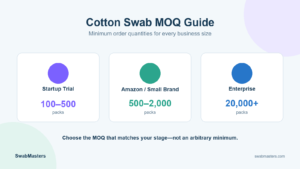
For detailed MOQ information and negotiation strategies, see: Cotton Swab MOQ Guide: Minimum Order Quantities Explained.
SwabMasters FBA-Ready Service: We handle everything from production to Amazon warehouse delivery — FNSKU labeling, poly-bagging, carton labels, and direct shipping to your designated FBA fulfillment center. Our MOQ starts at 500 packs with no premium surcharge. Get your FBA-ready quote →
Design Your Brand and Packaging
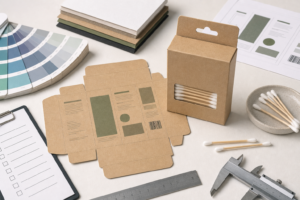
Your packaging design is the primary conversion driver on Amazon — 67% of shoppers say packaging design influences their purchase decision, and cotton swab listings with premium packaging photography achieve 2–3x higher click-through rates. In a category where the physical product is largely commoditized, your brand and packaging become the product.
Brand Positioning Framework
Before designing packaging, define your brand positioning using this framework:
| Element | Standard Approach (Avoid) | Premium Approach (Recommended) |
|---|---|---|
| Brand name | Generic ("EcoBuds") | Distinctive + memorable ("Willow & Birch") |
| Value proposition | "Eco-friendly cotton swabs" | "Zero-waste beauty rituals, crafted from sustainable bamboo" |
| Visual identity | Green leaf + earth tones | Minimalist, matte finish, single accent color |
| Packaging material | Standard cardboard | Unbleached kraft + soy ink printing |
| Unboxing experience | Plastic wrap | Tissue paper insert + thank-you card |
| Photography style | White background only | Lifestyle + bathroom setting + ingredient close-ups |
Packaging Design Requirements for Amazon FBA
Your packaging must satisfy both Amazon’s technical requirements and consumer appeal:
Amazon Technical Requirements:
- FNSKU barcode clearly visible (not obscured by poly-bag seam)
- Suffocation warning for poly-bags over 5" opening
- Product dimensions fit within Small Standard or Large Standard size tier
- No loose components that could separate during fulfillment
Consumer Appeal Requirements:
- Front panel tells your brand story in 3 seconds (material + count + key benefit)
- Side panels include usage instructions and certifications
- Back panel features ingredients/materials list and brand website
- QR code linking to product registration (builds email list)
Critical dimension optimization: Cotton swab packaging should be designed to fit within Amazon’s Small Standard size tier (max 15" × 12" × 0.75") to qualify for the lowest FBA fulfillment fee bracket. A 400-count bamboo cotton bud pack in a flat kraft box measuring 14" × 4" × 0.7" qualifies for this tier, potentially saving 20–25% on fulfillment fees compared to the Large Standard tier.
Calculate Your Profit Margins
A well-optimized private label cotton swab listing achieves 28–35% net margin after all costs — including product, fulfillment fees, referral fees, PPC advertising, and returns. The key to profitability is controlling your landed cost while pricing at the premium end of your sub-category.
Profit Margin Formula: How to Calculate Your Unit Economics
Rather than providing fixed prices (which vary by material, quantity, and market conditions), here is the framework to calculate your cotton swab profit margin for any product configuration:
Profit per unit = Selling Price − (Product Cost + Shipping + Amazon Fees + PPC + Returns)
Amazon Fee Structure (2026, fixed costs you can plan around)
| Fee Type | How It’s Calculated | Typical % of Selling Price |
|---|---|---|
| Referral fee | 15% of selling price | 15% |
| FBA fulfillment fee | Based on size tier and weight | 25–35% |
| Monthly storage fee | Per cubic foot, seasonal variation | 1–2% |
| Inbound placement fee | Per unit | 2–3% |
| PPC advertising | Variable (ACoS-dependent) | 5–15% (launch) / 3–8% (mature) |
| Returns allowance | ~3% of units sold | 3% |
| Total Amazon costs | 50–65% (launch) / 40–55% (mature) |
The Two Levers That Determine Your Margin
Lever 1: Manufacturing cost (your biggest variable)
Your per-pack manufacturing cost depends on order volume, material, and customization level. The relationship is non-linear — scaling from a first order to a mature reorder typically reduces product cost by 28–40%.
| Order Stage | Cost Reduction vs First Order | Typical Margin Impact |
|---|---|---|
| First order (500–1,000 packs) | Baseline | Break-even to low single-digit margins |
| Second order (1,000–2,000 packs) | -12–18% | 10–18% net margin |
| Scaled reorder (2,000–5,000 packs) | -28–40% | 20–30% net margin |
| Volume reorder (5,000+ packs) | -35–45% | 25–35% net margin |
Lever 2: PPC efficiency (improves with organic ranking)
During launch (Month 1–3), expect PPC to consume 10–15% of revenue. As organic ranking improves (Month 6+), this drops to 3–8%, directly boosting your net margin by 5–12 percentage points.
Key insight: Your cotton swab profit margin depends on two variables you control — (1) scaling order volume to reduce per-pack cost, and (2) building enough reviews and organic ranking to reduce PPC dependency. The path to 25–35% margins requires reaching scaled reorder volumes and achieving organic ranking on page 1 for your primary keywords.
Get your personalized margin model: Contact SwabMasters with your target product (material, count, packaging) and order volume — we’ll provide an exact cost quote so you can calculate your real unit economics before committing.
For a detailed breakdown of all manufacturing costs, read: What It Really Costs to Manufacture Cotton Swabs.
Create a High-Converting Amazon Listing
The top-performing private label cotton swab listings achieve 15–25% conversion rates — 3x the category average of 5–8% — through optimized titles, benefit-driven bullet points, and lifestyle photography that communicates brand values instantly. Your listing is your storefront, your sales pitch, and your brand experience combined into a single page.
Title Optimization Formula
Amazon allows 200 characters for titles in the Health & Household category. Use this proven structure:
Formula: [Brand] + [Material] + [Product Type] + [Count] + [Key Benefit] + [Secondary Benefit]
Example: Willow & Birch Bamboo Cotton Buds 500 Count – Biodegradable & Plastic-Free – Double-Tipped for Makeup & Ear Cleaning
Bullet Point Strategy (5 Bullets)
| Bullet # | Focus | Example |
|---|---|---|
| 1 | Primary benefit + differentiation | "100% BIODEGRADABLE — Our bamboo cotton buds decompose naturally in 90 days, unlike plastic swabs that persist in landfills for 500+ years" |
| 2 | Material quality + safety | "PREMIUM ORGANIC COTTON TIPS — Soft, lint-free cotton sourced from certified organic farms. Gentle enough for baby skin, precise enough for makeup application" |
| 3 | Quantity + value proposition | "500 COUNT VALUE PACK — 3–4 months supply for daily use. Subscribe & Save for an additional 15% off every delivery" |
| 4 | Certifications + trust signals | "FSC CERTIFIED BAMBOO — Sustainably harvested, pesticide-free bamboo sticks. Packaged in recyclable kraft paper. Zero plastic in product or packaging" |
| 5 | Versatility + use cases | "MULTI-PURPOSE DESIGN — Double-tipped with round and pointed ends for ear cleaning, makeup touch-ups, arts & crafts, first aid, and precision cleaning" |
Image Strategy (7+ Images Required)
| Image Position | Type | Content |
|---|---|---|
| Main image | Product on white | Pack front-facing, 85%+ frame fill |
| Image 2 | Lifestyle | Product in bathroom setting, morning routine context |
| Image 3 | Infographic | Material comparison (bamboo vs plastic), decomposition timeline |
| Image 4 | Close-up | Cotton tip quality, bamboo stick texture |
| Image 5 | Size reference | Pack in hand, individual swab next to coin |
| Image 6 | Use cases | 4-panel showing different applications |
| Image 7 | Certification/trust | FSC logo, organic cert, "plastic-free" badge, brand story |
Backend Keywords (Search Terms)
Include these high-volume keywords in your backend search terms field (250 bytes max):
cotton buds ear cleaning makeup remover swab qtip q-tip bamboo wooden eco friendly biodegradable organic natural sustainable zero waste plastic free double tip pointed cosmetic baby gentle hypoallergenic bulk pack value
Launch Strategy and PPC Advertising
A successful Amazon FBA cotton swabs launch requires 30–60 days of aggressive PPC spending at 40–60% ACoS to build initial velocity, followed by a gradual reduction to 15–25% ACoS as organic ranking improves. The launch phase is an investment — you are buying ranking position and review velocity, not immediate profit.
Week-by-Week Launch Plan
| Week | Action | Budget Strategy | Target ACoS | Expected Velocity |
|---|---|---|---|---|
| Week 1–2 | Aggressive auto + broad campaigns | High (invest for data) | 60–80% (acceptable) | 3–5 units/day |
| Week 3–4 | Add exact match, harvest converting terms | Peak (maximum reach) | 40–60% | 5–10 units/day |
| Week 5–6 | Optimize bids, pause non-performers, add negatives | Moderate (efficiency focus) | 30–45% | 8–15 units/day |
| Week 7–8 | Scale winners, reduce auto spend | Tapering (organic growing) | 25–35% | 12–20 units/day |
| Month 3+ | Maintenance mode, organic sales growing | Maintenance (profit mode) | 15–25% | 15–30+ units/day |
PPC Campaign Structure
Campaign 1: Auto (Discovery) — ~25% of total PPC budget
- Purpose: Discover converting search terms
- Action: Weekly search term report → move winners to exact match
Campaign 2: Broad Match (Expansion) — ~25% of total PPC budget
- Keywords: "bamboo cotton buds," "eco cotton swabs," "biodegradable cotton buds"
- Purpose: Capture long-tail variations
Campaign 3: Exact Match (Conversion) — ~35% of total PPC budget
- Keywords: Harvested from auto and broad campaigns with ACoS < 30%
- Purpose: Drive profitable sales on proven terms
Campaign 4: Product Targeting (Conquest) — ~15% of total PPC budget
- Target: Competitor ASINs (Sky Organics, other bamboo brands)
- Purpose: Capture comparison shoppers
Review Generation Strategy
Amazon’s Terms of Service prohibit incentivized reviews, but legitimate strategies exist to accelerate review velocity:
- Amazon Vine: Enroll your product (Amazon charges a fee per enrollment). Generates 15–30 verified reviews within 30 days.
- Request a Review button: Use Seller Central’s automated review request for every order.
- Package insert: Include a tasteful card asking for honest feedback (no incentive, no directing to 5-star).
- Subscribe & Save: Repeat customers are 3x more likely to leave reviews.
Scale Your Private Label Brand Beyond Launch
Successful cotton buds private label brands scale from a single SKU to a multi-SKU portfolio generating 5–10x their initial monthly revenue within 12–18 months by expanding into adjacent products, additional pack sizes, and multi-channel distribution. The foundation you build with your first product — identity, supplier relationship, customer base — becomes the platform for rapid expansion.
SKU Expansion Roadmap
| Timeline | Action | Expected Revenue Impact |
|---|---|---|
| Month 4–6 | Add second pack size (200ct travel size) | +30–40% revenue |
| Month 6–9 | Add complementary product (cotton pads or makeup remover pads) | +40–60% revenue |
| Month 9–12 | Launch premium variant (organic certified or specialty tips) | +25–35% revenue |
| Month 12–15 | Expand to Amazon UK/EU/CA | +30–50% revenue |
| Month 15–18 | Add Walmart Marketplace + wholesale inquiries | +40–60% revenue |
Reorder Optimization
As your brand grows, your per-unit economics improve dramatically through volume-based pricing:
| Order Size | Savings vs. First Order | Impact on Net Margin |
|---|---|---|
| 500 packs (first order) | Baseline | Break-even to low margins |
| 1,000 packs | -12–18% | +8–12 margin points |
| 2,000 packs | -28–35% | +15–20 margin points |
| 5,000+ packs | -35–45% | +20–25 margin points |
The exact cost per pack depends on your specific product configuration (material, count, packaging complexity). The percentage savings are consistent across product types — volume is the single most powerful lever for improving your unit economics.
For information on importing larger quantities, see our guide: How to Import Cotton Swabs from China: HS Codes, FDA Regulations & Customs Clearance.
Ready to scale? SwabMasters offers volume-based pricing with no long-term contracts. As your Amazon sales grow, your per-pack cost automatically decreases. We maintain dedicated inventory for our Amazon FBA clients to ensure 5-day turnaround on reorders. Discuss your scaling plan →
Frequently Asked Questions
How much does it cost to start a private label cotton swab business?
The startup cost for a private label cotton swab business varies based on your product configuration, order quantity, and shipping method. Key cost components include: product manufacturing (40–50% of total investment), packaging design and printing plates (10–15%, one-time), quality inspection (5–10%), shipping to Amazon warehouse (20–25%), and initial PPC budget. You can minimize your initial investment by starting with smaller quantities (500 packs), using semi-custom packaging (stock box + custom label), and shipping by sea rather than air. Contact SwabMasters for a customized cost estimate →
What profit margin can I expect selling private label cotton swabs on Amazon?
Private label cotton swabs on Amazon typically achieve 25–35% net profit margins once established (after Month 6+). During the launch phase (Months 1–3), expect break-even or slight losses as you invest in PPC and review building. Your margin depends on two controllable variables: (1) manufacturing cost, which decreases 28–40% as you scale from first order to volume reorders, and (2) PPC efficiency, which improves as organic ranking builds. Amazon fees (referral + fulfillment + storage) typically consume 40–55% of selling price. Eco-friendly bamboo variants achieve the highest margins due to their 100–200% retail price premium over standard products.
What is the minimum order quantity for private label cotton swabs?
The minimum order quantity for private label cotton swabs is typically 500–1,000 packs (100-count or 400-count bags/boxes) from a direct manufacturer. In the cotton swab industry, MOQ is counted in finished retail packs — not individual swabs. So "MOQ 500 PCS" means 500 packs. For Amazon FBA, 500 packs is the recommended starting quantity, providing 1–2 months of inventory while keeping initial investment manageable.
How do I find a reliable cotton swab manufacturer for Amazon FBA?
Start by identifying manufacturers (not trading companies) with verified export experience to Amazon FBA sellers. Key indicators of a reliable manufacturer: owns their production equipment, holds ISO 9001 certification, provides factory audit reports, offers FBA-ready packaging services, and can share references from existing Amazon seller clients. Request samples from 3–5 factories and evaluate cotton tip density, stick strength, packaging quality, and communication responsiveness before committing. Read our complete sourcing guide for detailed evaluation criteria.
Which type of cotton swabs sells best on Amazon?
Bamboo cotton buds are the fastest-growing segment on Amazon with 40%+ year-over-year growth. The top-performing private label cotton swab products in 2026 are bamboo cotton buds in 400–500 count packs (premium-priced), organic cotton swabs with paper sticks in 200–300 count (mid-premium), and pointed-tip precision swabs for makeup in 100–200 count (mid-premium). Eco-positioning allows 100–200% price premiums over standard products and attracts higher-converting, brand-loyal customers.
How long does it take to launch a cotton swab business?
Launching a private label cotton swab business takes 8–12 weeks from initial planning to first sale. The timeline: product research and supplier selection (1–2 weeks), sample ordering and evaluation (2–3 weeks), production and packaging (2–3 weeks for 500–1,000 packs), shipping to warehouse (2–3 weeks by sea or 1 week by air), and listing creation and launch (3–5 days). You can accelerate to 5–6 weeks by air-shipping your first order and using the manufacturer’s stock packaging with a custom label.
What Amazon FBA fees apply to cotton swabs?
Amazon FBA fees for cotton swabs (standard-size, under 12oz) in 2026 include: referral fee (15% of selling price), fulfillment fee (based on size tier and weight), monthly storage fee (varies seasonally — higher during Q4), and inbound placement fee (per unit). Total Amazon fees typically consume 40–55% of your selling price, making product sourcing cost the critical variable for profitability. The key optimization: design your packaging to fit within the Small Standard size tier (max 15" × 12" × 0.75") to access the lowest fulfillment fee bracket and maximize your net margin.
How do I optimize my Amazon listing for cotton swabs?
Optimize your listing with a keyword-rich title (brand + material + product + count + benefit), benefit-driven bullet points leading with eco/quality messaging, 7+ images including lifestyle and infographic shots, A+ Content with comparison tables, and backend search terms covering all relevant synonyms (cotton buds, q-tips, ear buds, swabs). The highest-converting listings use lifestyle photography showing the product in a clean, modern bathroom setting — not just white-background product shots.
Start Your Private Label Brand Today
The private label cotton swab opportunity combines low startup costs, high repeat purchase rates, and meaningful differentiation potential through eco-friendly materials and premium packaging. The sellers who succeed with Amazon FBA cotton swabs share three characteristics: they choose a clear niche (bamboo/eco is the strongest in 2026), they invest in packaging that photographs well, and they commit to the 60–90 day launch investment before expecting profitability.
Your next steps:
| Step | Action | Timeline |
|---|---|---|
| 1 | Request samples from 3 manufacturers | This week |
| 2 | Evaluate samples and select supplier | Week 2 |
| 3 | Finalize packaging design and place first order | Week 3 |
| 4 | Create Amazon listing while production runs | Week 4–5 |
| 5 | Receive inventory and ship to FBA | Week 6–8 |
| 6 | Launch with PPC and Vine enrollment | Week 8–9 |
Ready to source your first order? Contact SwabMasters for a free product consultation and customized pricing quote. We will recommend the optimal product configuration, pack size, and packaging approach based on your target market and budget — and provide exact per-pack costs for your specific requirements. Our Amazon FBA specialists have helped launch 200+ private label brands — we know exactly what works.
References
[1] Nova Analytics. "Amazon FBA Seller Profit Margin: 2026 Benchmarks by Category." novadata.io, May 2026.
[2] Amazon Seller Central. "Subscribe & Save Program Statistics." sellercentral.amazon.com, 2026.
[3] Commerce.ai. "Cotton Swabs Category Analysis." commerce.ai/reports/cotton-swabs, 2025.
[4] AMZChart. "Amazon Cotton Swabs Industry Analysis." amzchart.com, 2026.
[5] SwabMasters. "Cotton Swab MOQ Guide: Minimum Order Quantities Explained." swabmasters.com, 2026.
[6] Ipsos. "The Role of Packaging in Purchase Decisions." ipsos.com, 2024.
[7] Amazon Seller Central. "2026 US FBA Fulfillment Fee Changes." sellercentral.amazon.com, 2026.
[8] Helium 10. "Amazon Conversion Rate Benchmarks by Category." helium10.com, 2025.
[9] Jungle Scout. "Amazon PPC Advertising Benchmarks Report." junglescout.com, 2025.
[10] Amazon. "Amazon Selling Stats — Independent Sellers." sell.amazon.com/blog/amazon-stats, 2025.