Last updated: — Production and inspection sections updated for the Bazhou, Hebei factory.
A bad batch of cotton swabs can cost you thousands in returns, lost customers, and damaged brand reputation.
Loose cotton heads, damaged shafts and inconsistent packaging can escape attention when a buyer and supplier have not agreed how quality will be checked.
Here’s the deal:
You don’t need to be a quality expert to inspect cotton swabs properly. You just need to know what to check, when to check, and how to check.
This guide gives you a complete cotton swab quality inspection framework. Use it before every order.
Table of Contents
- Why Cotton Swab Quality Inspection Matters for B2B Buyers
- The 7 Critical Quality Checkpoints
- AQL Sampling: How Many Units to Inspect
- Cotton Swab Defect Classification
- When to Inspect: 4 Inspection Stages
- Third-Party Inspection vs. Self-Inspection
- Quality Inspection Checklist (Copy & Use)
- FAQ
Why Cotton Swab Quality Inspection Matters for B2B Buyers
Cotton swab quality inspection is the single most effective way to prevent costly product returns and protect your brand reputation.
Here’s why it matters more than you think:
A defective cotton swab isn’t just an annoyance. For Amazon FBA sellers, it triggers negative reviews. For private-label cotton swab brands, it leads to store delisting. For medical suppliers, it creates compliance violations.
The numbers tell the story:
| Quality Issue | Business Impact |
|---|---|
| Loose cotton heads | 1-star reviews, product returns |
| Bent sticks | Customer complaints, brand damage |
| Contamination | FDA recall risk, legal liability |
| Wrong labeling | Customs hold, shipment rejection |
| Inconsistent count | Consumer trust loss, FTC complaints |
The cost of inspection: A few hundred dollars per order.
The cost of skipping inspection: Thousands in returns, refunds, and lost customers.
Bottom line: Quality inspection isn’t an expense. It’s insurance.
Discuss inspection requirements for your cotton swab order →
The 7 Critical Quality Checkpoints for Cotton Swabs
Build your inspection plan around these seven checkpoints, adapting their sequence and methods to the product.
This practical sequence is designed to catch common issues before they reach your warehouse. Buyers planning overseas sourcing can also review our guide to importing cotton swabs from China.
1. Cotton Head Integrity
Compare cotton coverage, tip profile, cotton weight and firmness with the approved sample and specification. Single-ended, double-ended and shaped-tip products need different acceptance criteria.
Use a documented pull or retention test with agreed force, duration, fixture, conditioning and sample size. Record the measured result and failure mode. A subjective light pull alone is not a reproducible acceptance test.
2. Stick Strength and Straightness
Check shaft dimensions, straightness and surface condition against the specification. For wood and bamboo, include splinters and surface damage; for paper, check deformation and delamination; for plastic, confirm the specified material and dimensions.
Agree the bending or strength method for the intended use, including support spacing, load, test conditions and acceptance limit. One bend angle cannot serve as a pass/fail rule for every material and shaft design.
3. Adhesive Bond Quality
Inspect for exposed adhesive and an irregular cotton-to-shaft junction. Test retention using the agreed mechanical method rather than a universal twist-angle rule.
At SwabMasters’ Bazhou factory, controlled adhesive preparation helps reduce unnecessary exposure during mixing and delivery. Adhesive handling and the finished bond still require checks for the specific materials, process conditions and SKU.
4. Dimensional Consistency
Define nominal total length, shaft diameter, cotton-head length and diameter, and their tolerances on the approved drawing. Specify measurement locations, calibrated tools and sampling frequency. Record cotton or shaft weight where these are purchasing requirements.
There is no single dimensional tolerance suitable for every cotton swab. A short cosmetic tip and a long wooden applicator should not be evaluated against the same generic table.
5. Visual and Cosmetic Quality
Check the agreed tip profile, coverage, discoloration, visible foreign matter and shaft appearance. Use approved defect samples or photographs to separate acceptable variation from defects.
Automated vision inspection can check defined visible characteristics when the line is configured for that product. Confirm the actual inspection coverage and limitations for the quoted SKU; do not assume it measures bond strength, material composition or microbiological condition.
6. Packaging Integrity

Packaging protects the product and represents your brand. See our cotton swab packaging design guide for material, labeling, and branding considerations.
| Check Item | Pass Criteria |
|---|---|
| Seal integrity | No gaps, tears, or weak seals |
| Count accuracy | Count matches the label and the agreed acceptance requirements; do not assume a blanket shortage allowance |
| Print quality | Clear text, no smudging, correct colors |
| Barcode scan | Scans successfully on first attempt |
| Box structure | No crushing, denting, or moisture damage |
7. Labeling and Compliance
Wrong labels can get your shipment held at customs.
Verify:
- Country of origin clearly stated
- Product name and description accurate
- Net quantity declaration (count per pack)
- Manufacturer/importer information
- Only applicable and authorized markings; verify requirements for the intended use and destination
- Batch/lot number for traceability
Get SwabMasters' free labeling compliance checklist →
AQL Sampling: How Many Cotton Swabs to Inspect
A sampling plan must define the lot, inspection unit (individual swab, retail pack or carton), inspection level, severity, defect classes and acceptance/rejection numbers. Select the applicable plan with your quality team and use the current agreed standard or customer procedure.
AQL is an input to a lot-acceptance sampling plan, not a promise that a fixed percentage of defective goods is acceptable in every shipment. Major, minor and critical findings need an agreed disposition rule. Medical and other regulated products require a product-specific quality plan.
Confirm the sample size and acceptance/rejection counts from the selected plan before inspection. Do not copy a generic table without checking its inspection level and unit of inspection. In-line inspection and shipment sampling serve different purposes and can be used together.
Cotton Swab Defect Classification
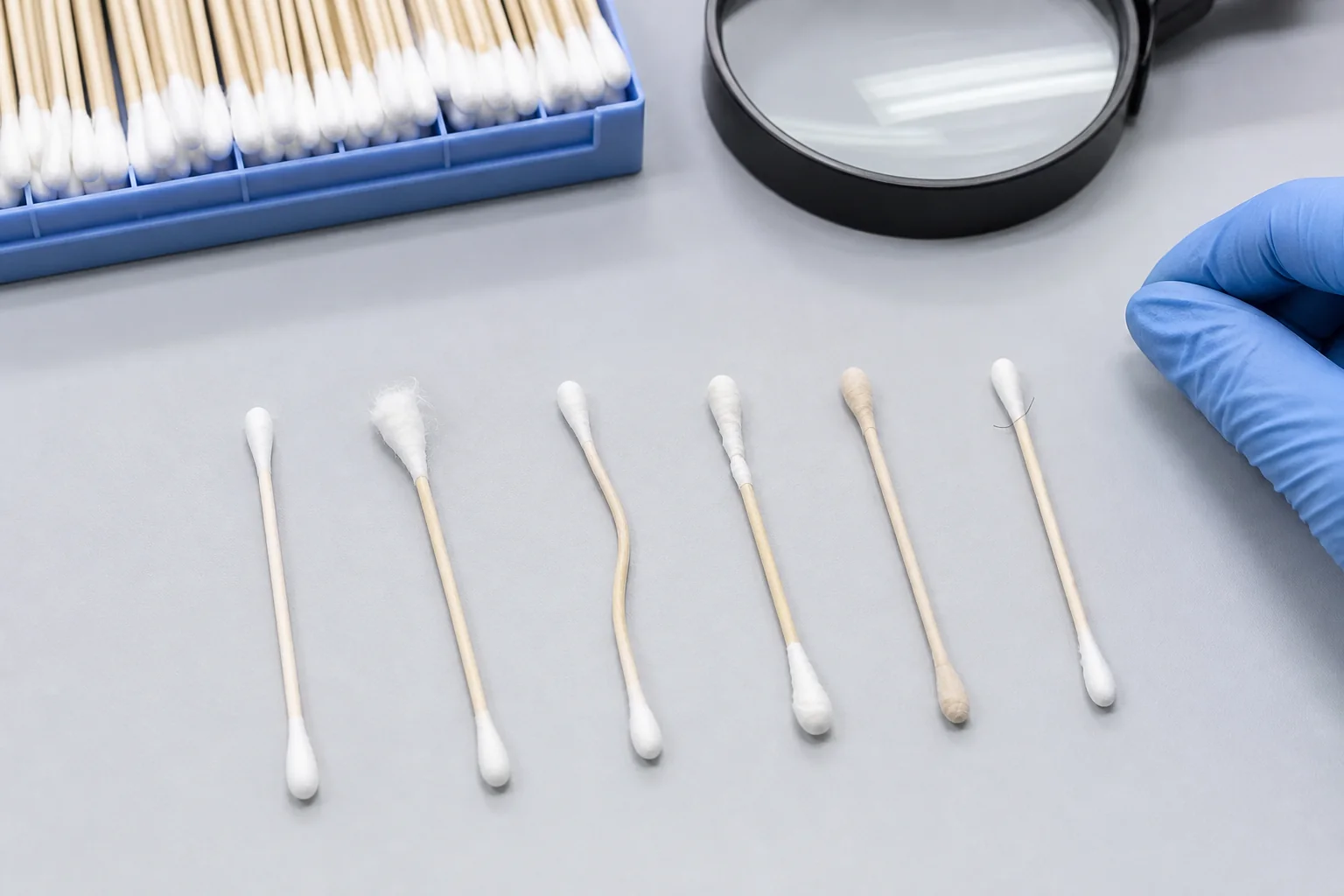
Not all defects are equal. Classify them into three levels to make accept/reject decisions faster.
| Level | Definition | Examples | Action |
|---|---|---|---|
| Critical | Safety hazard or regulatory violation | Contamination, sharp stick ends, wrong chemical composition | Reject entire batch |
| Major | Product fails its intended function | Cotton detaches, stick breaks easily, wrong dimensions | Apply the agreed major-defect acceptance/rejection plan |
| Minor | Cosmetic issue, product still functional | Slight discoloration, minor stick curvature, small print defect | Apply the agreed minor-defect acceptance/rejection plan |
Examples of Cotton Swab Defects and Possible Causes
| Rank | Defect | Classification | Root Cause |
|---|---|---|---|
| 1 | Loose cotton head | Major | Insufficient adhesive or low cotton density |
| 2 | Stick bending | Minor/Major | Material too thin or moisture absorption |
| 3 | Uneven cotton wrapping | Minor | Machine calibration drift |
| 4 | Count shortage | Major | Packaging machine counter error |
| 5 | Cotton discoloration | Minor | Raw material quality or storage conditions |
| 6 | Packaging seal failure | Major | Heat seal temperature incorrect |
| 7 | Foreign fiber contamination | Critical | Poor factory hygiene control |
Discuss which visible defects our in-line inspection can check for your SKU →
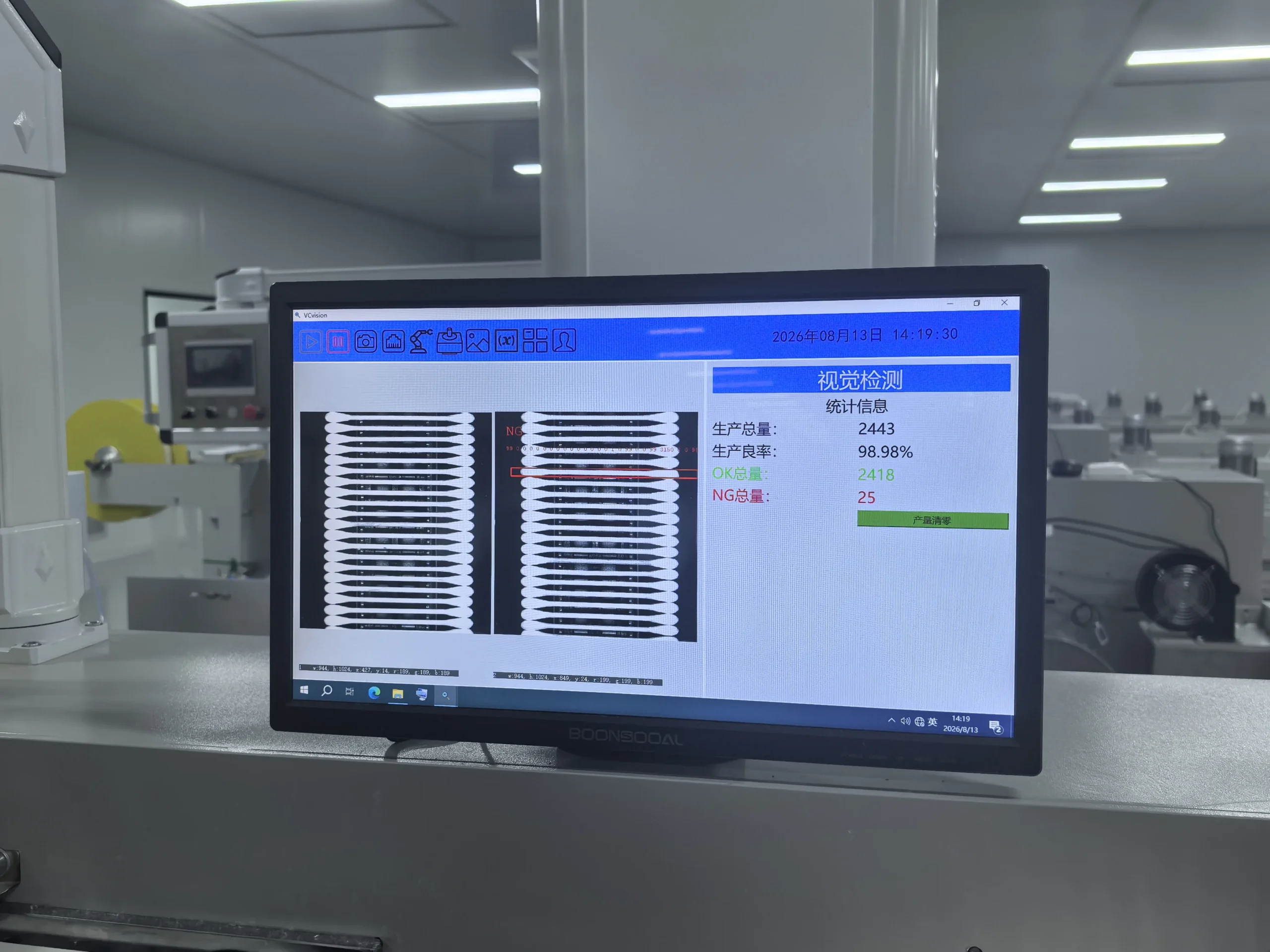
How In-Line Vision Inspection, Rejection and Count Compensation Work
SwabMasters’ new factory in Bazhou, Hebei combines a controlled clean production environment with automated production and bag-packing equipment. Enclosed extraction at cotton-dust-generating points and controlled adhesive preparation support the process, while reducing unnecessary manual handling is part of the production design.
- Define the inspection: use the approved product specification and defect examples to establish the visible features to be checked for the selected SKU.
- Inspect and reject: the vision system identifies defined visible defects and the rejection mechanism removes pieces judged nonconforming.
- Compensate the count: the line replaces rejected pieces to help maintain the specified pack quantity. Verify this function for the planned product and packaging configuration.
- Verify the finished pack: check quantity, seals, labels and batch identification under the order’s quality plan. An automatic counter does not remove the need for finished-pack checks.
Operators remain responsible for setup, replenishment, monitoring and responding to abnormal conditions. For a factory review, ask to see inspection and rejection in operation and discuss how settings, checks and corrective actions are handled. Independent sampling, retention testing and any required laboratory work remain separate parts of product qualification.
Send your SKU, packaging format and acceptance criteria to discuss an inspection and sampling plan.
When to Inspect: 4 Inspection Stages for Cotton Swab Orders
The best time to catch quality problems is before they become expensive. Here are the four inspection windows available to B2B buyers.
| Stage | When | What You Check | Best For |
|---|---|---|---|
| Pre-production | Before manufacturing starts | Raw materials (cotton, sticks, adhesive, packaging) | First-time orders, new suppliers |
| During production (DUPRO) | When 20–30% of order is complete | Process quality, early defect detection | Large orders (5,000+ packs) |
| Pre-shipment inspection (PSI) | After production, before shipping | Finished product quality, packaging, labeling | Every order (minimum recommended) |
| Container loading | During container stuffing | Loading method, quantity, damage prevention | Full container orders (FCL) |
Our recommendation for most buyers:
- First order with new supplier: Pre-production + final inspection before shipping
- Repeat orders: Final inspection before shipping only
- Large orders (5,000+ packs): During production + final inspection
Third-Party Inspection vs. Self-Inspection
An independent inspector provides direct access to the goods and a report against your agreed specification. Remote photographs or video can help explain the process, but do not provide the same independence or sampling control.
Choose the inspection arrangement according to product risk, order history, customer requirements and shipment value. Obtain a current quotation specifying scope, location, travel, sample size, tests and reporting time. Do not waive independent inspection solely because a supplier has cameras on the production line.
Discuss the factory review, inspection access and order documentation you need.
Cotton Swab Quality Inspection Checklist
Before production
- Approve the specification, golden sample and packaging artwork.
- Define defect classes, mechanical test methods and lot sampling rules.
- Confirm material evidence and any destination-specific requirements.
During production
- Check setup and first-off samples for the actual SKU.
- Review visible-defect checks, rejection and count compensation where applicable.
- Record process checks and investigate abnormal results.
Before shipment
- Draw samples across the lot using the agreed plan.
- Check tip retention, dimensions and shaft performance with the specified methods.
- Verify finished-pack quantity, seals, artwork, barcode and batch identification.
- Record results, nonconformities, disposition and any reinspection.
FAQ
Does vision inspection replace sampling?
No. Vision inspection addresses configured visible features. Sampling and the agreed mechanical, packaging or laboratory tests address other acceptance requirements.
Which AQL should I use?
Agree the sampling standard, inspection level, unit of inspection, severity and defect classifications with your quality team. Use the corresponding acceptance/rejection plan; no single AQL is appropriate for all cotton swabs and markets.
How do I verify pack quantity?
Confirm the counting and rejection-compensation process for your packing configuration, then count finished packs according to the agreed acceptance plan. Define how any shortage is handled before production.
Does a clean workshop mean the product is sterile?
No. A controlled production environment does not establish product sterility. Any sterile-product requirement needs a separately qualified process and product-specific evidence.
How do I verify material quality?
Match incoming material identification and supplier documentation to the approved specification. Where composition or performance matters, agree appropriate testing with a qualified laboratory rather than relying on visual appearance alone.
Summary: Your Quality Inspection Action Plan
Here’s your step-by-step action plan:
Step 1: Define your quality standards (AQL level, defect tolerance).
Step 2: Decide inspection type (third-party for new suppliers, self-inspection for trusted ones).
Step 3: Use the 7-checkpoint framework above for every order.
Step 4: Document everything with photos and measurements.
Step 5: Make clear accept/reject decisions based on AQL results.
The easiest way to avoid quality problems? Work with a manufacturer that inspects before you have to.
Ask SwabMasters about the inspection documentation, photos, and video reporting available for your order.
Request a sample order with full quality documentation →
References
[1]: Falu. "The Challenge of a Quality Control System in a Swab Machine." https://www.falu.com/the-challenge-of-a-quality-control-system-in-a-swab-machine/
[2]: ISO. "ISO 2859-1: Sampling procedures for inspection by attributes." https://www.iso.org/standard/1141.html
[3]: QIMA. "Acceptable Quality Limit, AQL Sampling Chart and Calculator." https://www.qima.com/aql-acceptable-quality-limit
[4]: Tetra Inspection. "Product Inspection & Quality Control China." https://tetrainspection.com/quality-control-china/