By Mike Zhang, Manufacturing Director at SwabMasters | Last updated: May 2026
Sourcing cotton swabs from China is the most cost-effective way to build a profitable cotton bud brand. China produces an estimated 60–70% of the world’s cotton swabs, and manufacturers here offer unmatched flexibility in materials, packaging, and minimum order quantities.
But here’s the problem most first-time buyers face:
You don’t know who to trust. Alibaba listings all look the same. Pricing feels like a black box. And one bad shipment can destroy your brand before it even launches.
This guide fixes that.
As a cotton swab manufacturer with 25 years of export experience, we’ve shipped to buyers in over 50 countries. We’ve seen every mistake a first-time importer can make — and we’ve helped hundreds of brands avoid them.
Whether you’re an Amazon FBA seller looking for your first private label product, a distributor expanding your catalog, or a hospital procurement officer sourcing medical-grade swabs, this guide gives you the insider knowledge you need to source cotton swabs from China with confidence.
Why China Dominates Cotton Swab Manufacturing
China’s dominance in cotton swab production isn’t accidental. It’s the result of three structural advantages that no other country can currently match.
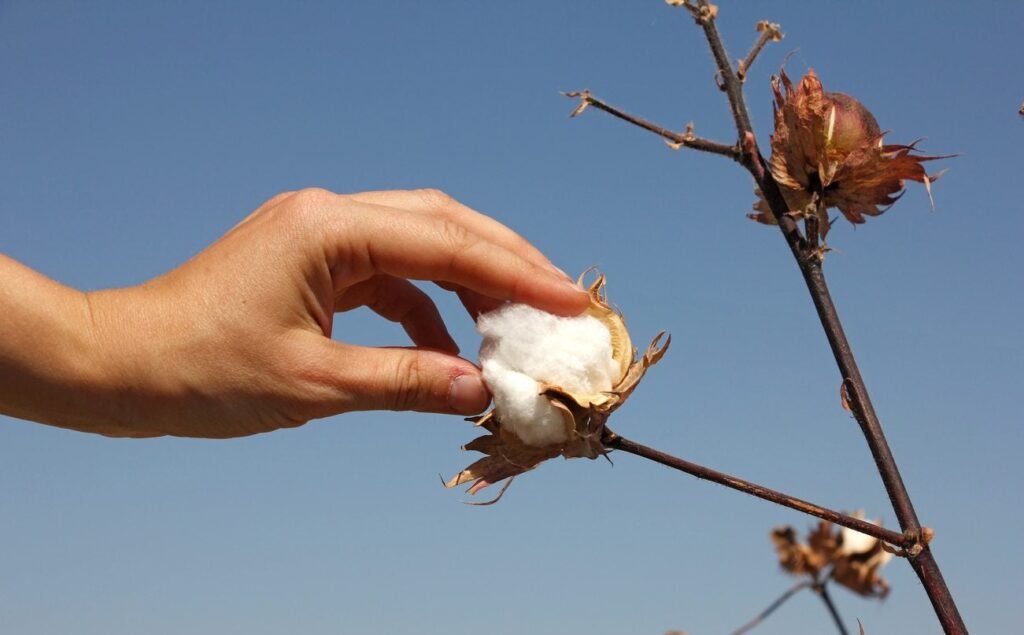
First, the raw material supply chain. China is the world’s largest cotton producer and consumer, with domestic production reaching approximately 6.17 million metric tons in the 2024/25 marketing year . Cotton swab manufacturers in Dongguan, Suzhou, and Zhejiang have direct access to spinning mills, paper stick factories, and packaging suppliers — all within a 200-kilometer radius. This vertical integration keeps costs 30–50% lower than manufacturers in Southeast Asia or India.
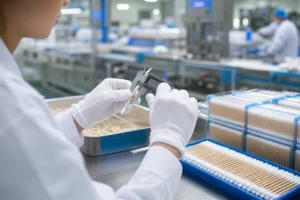
Second, the manufacturing infrastructure. China has the world’s largest installed base of high-speed cotton swab machines. A modern production line can produce 800–1,200 cotton swabs per minute, with automated tip-forming, stick insertion, and quality inspection. SwabMasters alone operates 58 machines across 10,000 square meters of ISO-certified factory space, producing over 20 million cotton swabs daily.
Third, the OEM/ODM ecosystem. Chinese manufacturers have decades of experience producing private label products for global brands. From custom stick materials (bamboo, paper, wood, plastic) to branded packaging design, the entire customization process is streamlined. Most factories can deliver finished samples within 7–10 days.
| Factor | China | India | Southeast Asia |
| Share of global production | 60–70% | 10–15% | 5–8% |
| Average FOB price (per 100-pack) | $0.08–$0.20 | $0.10–$0.25 | $0.12–$0.30 |
| Typical MOQ | 5,000–100,000 pcs | 50,000–200,000 pcs | 20,000–100,000 pcs |
| Sample lead time | 7–10 days | 14–21 days | 10–15 days |
| Customization flexibility | Very high | Medium | Medium |
| Certifications available | ISO, FDA, CE, GOTS | ISO, BIS | ISO, some FDA |
How Much Do Cotton Swabs from China Actually Cost?
This is the question every buyer asks first. And the honest answer is: it depends on five variables.
The FOB (Free on Board) price of cotton swabs from China varies dramatically based on the product type, stick material, tip configuration, packaging format, and order volume. Here’s a transparent breakdown based on real factory pricing as of May 2026.
FOB Price Ranges by Product Type
| Product Type | Stick Material | Tip Type | FOB Price (per piece) | FOB Price (per 100-pack) | Typical MOQ |
| Basic daily-use cotton buds | Plastic (PP) | Single-head, standard | $0.003–$0.005 | $0.08–$0.12 | 10,000 packs |
| Eco-friendly cotton buds | Paper | Single-head, standard | $0.006–$0.008 | $0.18-$0.20 | 10,000 packs |
| Bamboo cotton buds | Bamboo | Single-head, standard | $0.004–$0.006 | $0.1–$0.14 | 10,000 packs |
| Cosmetic/pointed tip swabs | Plastic or paper | Pointed + round | $0.005–$0.010 | $0.12–$0.25 | 10,000 packs |
| Medical-grade sterile swabs | Wood or plastic | Large oval tip | $0.02–$0.08 | N/A (individually packed) | 10,000 pcs |
| Industrial precision swabs | Plastic | Foam or microfiber | $0.03–$0.15 | N/A (individually packed) | 5,000 pcs |
| Iodine/antiseptic swabs | Plastic (sealed) | Pre-saturated | $0.04–$0.15 | N/A (individually packed) | 5,000 pcs |
The Five Factors That Determine Your Price
Factor 1: Stick material. Plastic sticks are cheapest ($0.001–$0.002 per stick). Paper sticks cost 20–40% more due to the materials and rolling and gluing process. Bamboo sticks carry around 5% premium over plastic but command higher retail prices in eco-conscious markets. Wooden sticks (birch) almost same as bamboo.
Factor 2: Cotton tip quality. Standard tips use recycled cotton fibers and cost less. Premium tips use 100% virgin cotton with higher density (measured in grams per tip). Medical-grade tips require purified absorbent cotton that meets pharmacopeia standards, adding $0.005–$0.02 per piece.
Factor 3: Packaging format. A simple poly bag with header card is the cheapest option ($0.01–$0.03 per pack). A printed cardboard box costs $0.03–$0.08. A round canister (like Q-tips brand) costs $0.05–$0.15. Eco-friendly kraft paper packaging falls in the $0.04–$0.10 range.
Factor 4: Order volume. This is where the biggest savings happen. A 10,000-pack order might cost $0.18 per 100-pack. Scale that to 100,000 packs, and the price drops to $0.10–$0.12. At 500,000+ packs, you’re looking at $0.08–$0.09.
Factor 5: Certifications and testing. If you need FDA registration, CE marking, ISO 13485 compliance, or third-party lab testing (SGS, Intertek), these add $2,000–$8,000 in one-time costs plus ongoing audit fees.
Pro Tip from SwabMasters: “Don’t chase the lowest price. We’ve seen buyers save $0.01 per piece on cotton tips, only to lose $50,000 when an entire container failed Amazon’s quality inspection. The $0.01 you save on cotton quality is the $0.01 that gets your listing suspended.” — Mike Zhang, Manufacturing Director
Understanding MOQ: Minimum Order Quantities Explained
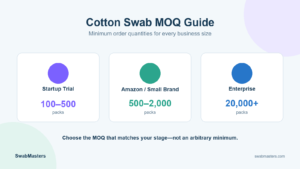
For detailed order-size recommendations by business stage, product type, customization level, and pricing tier, see our complete guide to understanding MOQ requirements.
MOQ (Minimum Order Quantity) is the smallest number of units a factory will produce in a single production run. For cotton swabs sourced from China, MOQs vary widely depending on the supplier type and product complexity.
Many first-time buyers are shocked by high MOQs. A large factory might quote 100,000 packs as their minimum. For a small Amazon seller or startup brand, that’s a $10,000–$20,000 commitment before you’ve sold a single unit.
Here’s how MOQs actually work in the cotton swab industry:
MOQ by Supplier Type
| Supplier Type | Typical MOQ | Price Level | Best For |
| Large factory (own brand) | 50,000–200,000 packs | Lowest | Established brands, large distributors |
| Mid-size OEM factory | 10,000–50,000 packs | Low–Medium | Growing brands, regional distributors |
| Flexible OEM factory (e.g., SwabMasters) | 5,000–20,000 packs | Medium | Amazon sellers, startups, small importers |
| Trading company | 1,000–5,000 packs | Highest (20–40% markup) | Micro-orders, market testing |
How to Negotiate Lower MOQs
The key to negotiating a lower MOQ is understanding the factory’s cost structure. Every production run requires machine setup time (typically 2–4 hours), material changeover, and quality calibration. The factory needs enough volume to cover these fixed costs.
Strategy 1: Accept a slightly higher unit price. Most factories will lower their MOQ if you agree to pay 10–15% more per unit. This is often the best deal for first-time buyers — you reduce your risk while the factory covers their setup costs.
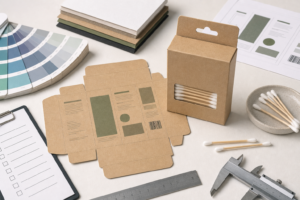
Strategy 2: Use the factory’s existing molds and packaging. Custom packaging requires new printing plates ($200–$500 each). If you use the factory’s standard packaging with just a sticker label, the MOQ drops significantly because there’s no setup cost.
Strategy 3: Combine products in one order. If you’re sourcing both cotton swabs and cotton pads, combining them into a single order gives the factory more total revenue, making them more willing to lower the MOQ on individual items.
Strategy 4: Start with a trial order, then commit to a forecast. Tell the factory: “I want to start with 5,000 packs as a trial. If quality meets our standards, we’ll order 50,000 packs within 6 months.” This gives the factory confidence in future volume.
At SwabMasters, we’ve designed our production system specifically for flexible MOQs. Our minimum starts at just 5,000 pieces for standard products — one of the lowest in the industry for a direct manufacturer (not a trading company). Contact us for a custom quote →
Step-by-Step: How to Source Cotton Swabs from China
Sourcing cotton swabs from China follows a predictable process. Here are the seven steps that successful importers follow, based on our experience working with buyers in over 50 countries.
Step 1: Define Your Product Specifications
Before contacting any supplier, document exactly what you need. This saves weeks of back-and-forth. Your specification sheet should include the stick material and length, tip shape and cotton weight, quantity per pack, packaging type and dimensions, any required certifications, and your target retail price point.
Step 2: Find and Vet Potential Suppliers
There are four main channels for finding cotton swab suppliers in China:
Alibaba and Made-in-China are the most common starting points. Look for “Gold Suppliers” with trade assurance and at least 5 years of verified operation. However, be aware that many listings are from trading companies, not actual factories.
Canton Fair and trade shows let you meet manufacturers face-to-face and inspect samples on the spot. The Canton Fair (held in Guangzhou every April and October) has a dedicated section for hygiene and personal care products.
Google search for terms like “cotton swab manufacturer China” or “cotton bud factory OEM.” Manufacturers with their own websites (rather than just Alibaba stores) tend to be more established and professional.
Industry referrals from logistics companies, quality inspection firms, or other non-competing importers are often the most reliable source.
Step 3: Request Samples and Compare
Request samples from at least 3–5 suppliers. A professional manufacturer will send samples within 7–10 days, often for free (you pay shipping). When evaluating samples, check the cotton tip firmness (squeeze test — the tip should not detach easily), stick straightness and strength (bend test), packaging seal integrity, and overall finish quality.
Step 4: Negotiate Pricing and Terms
Once you’ve narrowed down to 2–3 suppliers, negotiate the FOB price, payment terms (typically 30% deposit + 70% before shipment or against B/L COPY for new buyers), production lead time (usually 30–35 days after deposit), and sample approval process.
Step 5: Arrange Quality Inspection
Never skip this step. Hire a third-party inspection company (SGS, Bureau Veritas, or AsiaInspection) to conduct a pre-shipment inspection. The cost is typically $250–$400 per inspection day. They’ll check the product against your approved sample and specification sheet, using AQL (Acceptable Quality Level) sampling standards.
Key inspection points for cotton swabs include tip adhesion strength, stick dimensions and straightness, cotton weight per tip, packaging accuracy (correct count per pack), and labeling compliance.
Step 6: Handle Shipping and Customs
Cotton swabs are classified under HS Code 5601.21 (articles of cotton wadding) . The US import duty rate is 4.7% ad valorem . For EU imports, the duty rate varies by country but typically ranges from 3–5%.
| Shipping Method | Cost Estimate | Transit Time | Best For |
| Sea freight (FCL, 40ft container) | $3,500–$6,000 | 15–35 days | Large orders (50,000+ packs) |
| Sea freight (LCL) | $50–$80 per CBM | 20–40 days | Medium orders (10,000–50,000 packs) |
| Air freight | $4–$8 per kg | 3–7 days | Urgent or small orders |
| Express (DHL/FedEx) | $6–$10 per kg | 3–5 days | Samples or micro-orders |
A standard 40-foot container can hold approximately 25,000–35,000 packs of 100-count cotton swabs, depending on packaging dimensions.
Step 7: Build a Long-Term Supplier Relationship
The most successful importers treat their Chinese supplier as a partner, not just a vendor. Share your sales data and forecasts so the factory can plan production. Visit the factory at least once a year if possible. Provide clear, timely feedback on quality issues. Pay on time — this is the single most effective way to get priority treatment during peak season.
Quality Control: The Make-or-Break Factor
Quality control is where most cotton swab sourcing projects succeed or fail. The FDA’s Import Alert 79-01 specifically targets cotton products from overseas manufacturers that fail microbiological contamination standards . A single failed shipment can result in customs detention, product destruction, and lasting damage to your brand reputation.
The 6-Point Quality Checklist for Cotton Swabs
Check 1: Cotton tip adhesion. Pull the cotton tip with moderate force. It should not detach from the stick. Industry standard requires a minimum pull-off force of 1.5N (newtons). At SwabMasters, our production line tests every batch at 2.0N minimum — 33% above the industry standard.
Check 2: Stick strength. Apply lateral pressure to the stick at the midpoint. A quality plastic stick should withstand at least 3N of bending force without snapping. Paper and bamboo sticks should withstand 2N minimum.
Check 3: Cotton weight consistency. Weigh a sample of 20 cotton tips. The standard deviation should not exceed 10% of the target weight. Inconsistent cotton weight means inconsistent product quality on the shelf.
Check 4: Microbial testing. For medical-grade and baby-care cotton swabs, request a microbial test report from an accredited lab. Total aerobic count should be below 100 CFU/g, with zero detection of E. coli, Staphylococcus aureus, and Pseudomonas aeruginosa.
Check 5: Packaging integrity. Check that sealed packages are airtight (no pinholes), printed information is accurate and legible, barcodes scan correctly, and the pack count is accurate (count 10 random packs).
Check 6: Regulatory compliance. Verify that the product meets the regulatory requirements of your target market. For the US, this means FDA establishment registration for medical-use swabs. For the EU, CE marking and compliance with the Medical Devices Regulation (MDR) for medical products, or the EU Single-Use Plastics Directive for consumer products.
FDA, CE & Regulatory Compliance for Cotton Swab Imports
Understanding the regulatory landscape is critical for avoiding costly mistakes at customs. Here’s what you need to know for the two largest import markets.
United States (FDA)
Cotton swabs sold for cosmetic or general household use in the US do not require FDA approval. However, if the product is marketed for medical use (wound care, specimen collection, antiseptic application), it is classified as a Class I medical device under FDA Product Code KXF (“Applicator, Absorbent Tipped, Non-Sterile”) .
Class I medical devices are exempt from 510(k) premarket notification, but the manufacturer must register their establishment with the FDA and list the device. At SwabMasters, our factory is FDA-registered, which means our buyers can import medical-grade cotton swabs without additional regulatory hurdles.
European Union (CE)
For consumer-use cotton swabs, the main regulatory concern in the EU is the Single-Use Plastics Directive (EU 2019/904), which bans cotton buds with plastic sticks in all EU member states since July 2021. If you’re selling to EU markets, you must use paper, bamboo, or wooden sticks.
For medical-use cotton swabs, CE marking under the Medical Devices Regulation (MDR 2017/745) is required. This involves a conformity assessment, technical documentation, and (for sterile products) involvement of a Notified Body.
| Market | Consumer Use | Medical Use |
| USA | No FDA approval needed; HS 5601.21; 4.7% duty | FDA Class I device; establishment registration required |
| EU | No plastic sticks (SUP Directive); CE marking for safety | CE marking under MDR 2017/745; Notified Body for sterile |
| UK | Same as EU post-Brexit (UKCA marking) | UKCA marking under UK MDR 2002 |
| Australia | TGA listing not required for non-medical | TGA Class I listing required |
How to Spot a Trading Company vs. a Real Factory
One of the biggest traps in sourcing from China is accidentally working with a trading company that pretends to be a factory. Trading companies add a 20–40% markup without adding any value. Here’s how to tell the difference.
Red flag 1: They sell everything. If a “cotton swab factory” also sells face masks, wet wipes, diapers, and rubber gloves, it’s almost certainly a trading company. A real factory specializes in one or two product categories.
Red flag 2: They can’t answer technical questions. Ask about the cotton tip weight in grams, the stick diameter tolerance, or the machine speed. A real factory manager knows these numbers by heart. A trading company salesperson will say “let me check with the factory.”
Red flag 3: They refuse factory visits. A legitimate manufacturer will welcome you to visit their production line. If they make excuses or offer to “meet at a hotel nearby,” walk away.
Red flag 4: Their address is an office building. Check the supplier’s registered address on Google Maps. If it’s a commercial office tower in downtown Guangzhou or Shanghai, it’s a trading company. Factories are located in industrial zones.
Red flag 5: No production photos or videos on their website. A real factory proudly shows their machines, production lines, and cleanroom facilities. Trading companies use stock photos or photos borrowed from the actual factory.
At SwabMasters, we invite every serious buyer to visit our 10,000 sqm factory in Dongguan. We’ll show you our 58 production machines, our GMP-certified cleanroom, and our in-house quality testing lab. Schedule a factory visit →
Frequently Asked Questions About Sourcing Cotton Swabs from China
What is the minimum order quantity (MOQ) for cotton swabs from China?
MOQs vary by supplier type. Large factories typically require 50,000–200,000 packs minimum. At SwabMasters, our MOQ starts at just 5,000 pieces for standard products, making us one of the most accessible direct manufacturers for small and medium-sized buyers.
How long does it take to produce and ship cotton swabs from China?
Production typically takes 30–35 days after deposit payment and sample approval. Sea freight to the US West Coast takes 15–20 days, and to Europe 25–35 days. Total lead time from order to delivery is usually 5–8 weeks.
Do I need FDA approval to import cotton swabs into the US?
For consumer-use cotton swabs (cosmetic, household), no FDA approval is needed. For medical-use cotton swabs, the product is classified as a Class I medical device (Product Code KXF), which is exempt from 510(k) but requires the manufacturer to have FDA establishment registration .
What is the HS code and import duty for cotton swabs?
Cotton swabs are classified under HS Code 5601.21.0090. The US import duty rate is 4.7% ad valorem . Additional tariffs may apply depending on current trade policies — always check the latest HTS schedule before placing an order.
Can I get custom packaging and private labeling?
Yes. Most Chinese cotton swab manufacturers offer full OEM/ODM services, including custom stick materials, tip configurations, packaging design, and brand labeling. At SwabMasters, we provide free packaging design support and can produce custom samples within 7–10 days.
How do I verify a supplier is a real factory and not a trading company?
Request a factory video tour, ask detailed technical questions about production capacity and machine specifications, verify their business license on China’s National Enterprise Credit Information Publicity System (NECIPS), and check if their address is in an industrial zone rather than a commercial office building.
What quality certifications should I look for?
For consumer products: ISO 9001 (quality management) and SGS/Intertek test reports. For medical products: ISO 13485 (medical device quality management), FDA establishment registration, and CE marking. For eco-friendly products: FSC certification (for wood/bamboo) and GOTS (for organic cotton).
What happens if I receive defective products?
A reputable manufacturer will have a clear quality guarantee policy. At SwabMasters, we offer free replacement or full refund for any batch that fails to meet the agreed specifications. We also carry product liability insurance for additional buyer protection.
Ready to Source Cotton Swabs from China?
You now have the complete playbook for sourcing cotton swabs from China — from pricing and MOQs to quality control and regulatory compliance.
The next step is simple: get a quote from a manufacturer you can trust.
SwabMasters has been manufacturing cotton swabs for 23 years. We’ve exported to over 50 countries, operate 58 production machines in our 10,000 sqm GMP-certified factory, and hold ISO 9001, ISO 13485, FDA, and CE certifications.
Whether you need 5,000 pieces for a market test or 5 million pieces for a national retail launch, we have the capacity and flexibility to deliver.
Request a Free Quote → | WhatsApp: +86150 1539 1096 | Email: mike@swabmasters.com
References
[1] Where Are Cotton Swabs Manufactured? A Global Overview — SwabMasters
[2] Cotton and Products Annual — USDA Foreign Agricultural Service, April 2026
[3] HS Code for Cotton Swab — Deepbeez, May 2026
[4] Classification of Medical Use Cotton Tip Applicators — U.S. Customs and Border Protection
[5] Import Alert 79-01: Detention of Topical Bandages, Dressings, Gauzes and Cotton Pads — FDA
[6] Cotton Swabs — FDA Establishment Registration & Device Listing