Table of Contents
- Why Cotton Swab Packaging Design Matters for OEM Buyers
- Cotton Swab Packaging Materials Compared
- Sustainable Packaging Certifications for Cotton Swabs
- FDA Labeling Requirements for Cotton Swab Packaging
- EU Regulations and Single-Use Plastics Directive
- Packaging Dimensions and Size Optimization
- Branding Strategy for Cotton Swab Packaging
- Packaging Design for Amazon and E-commerce
- Common Packaging Design Mistakes to Avoid
- Frequently Asked Questions
Why Cotton Swab Packaging Design Matters for OEM Buyers
Packaging is the single most controllable differentiator for OEM buyers — it determines shelf appeal, regulatory compliance, fulfillment costs, and brand perception, while the product inside remains largely standardized across manufacturers. In a category where the core product (a cotton tip on a stick) offers limited functional differentiation, packaging design becomes the primary vehicle for brand storytelling, premium positioning, and competitive advantage.
For OEM buyers sourcing cotton swabs from China, OEM packaging decisions must be made early in the product development process because they directly impact manufacturing timelines, per-unit costs, regulatory compliance, and channel suitability. A packaging design that works beautifully on retail shelves may fail Amazon FBA size tier requirements. A material choice that satisfies US regulations may violate EU single-use plastics rules.
This guide covers every aspect of packaging design that OEM buyers need to understand before placing their first order — from material selection and regulatory compliance to branding strategy and cost optimization. Whether you are launching a private label cotton swab brand on Amazon or supplying retail chains, the packaging decisions outlined here will determine your product’s market success.
SwabMasters Advantage: With 23 years of OEM packaging experience and in-house structural design capabilities, we help buyers navigate material selection, regulatory compliance, and cost optimization for every target market. Request a free packaging consultation →
Cotton Swab Packaging Materials Compared
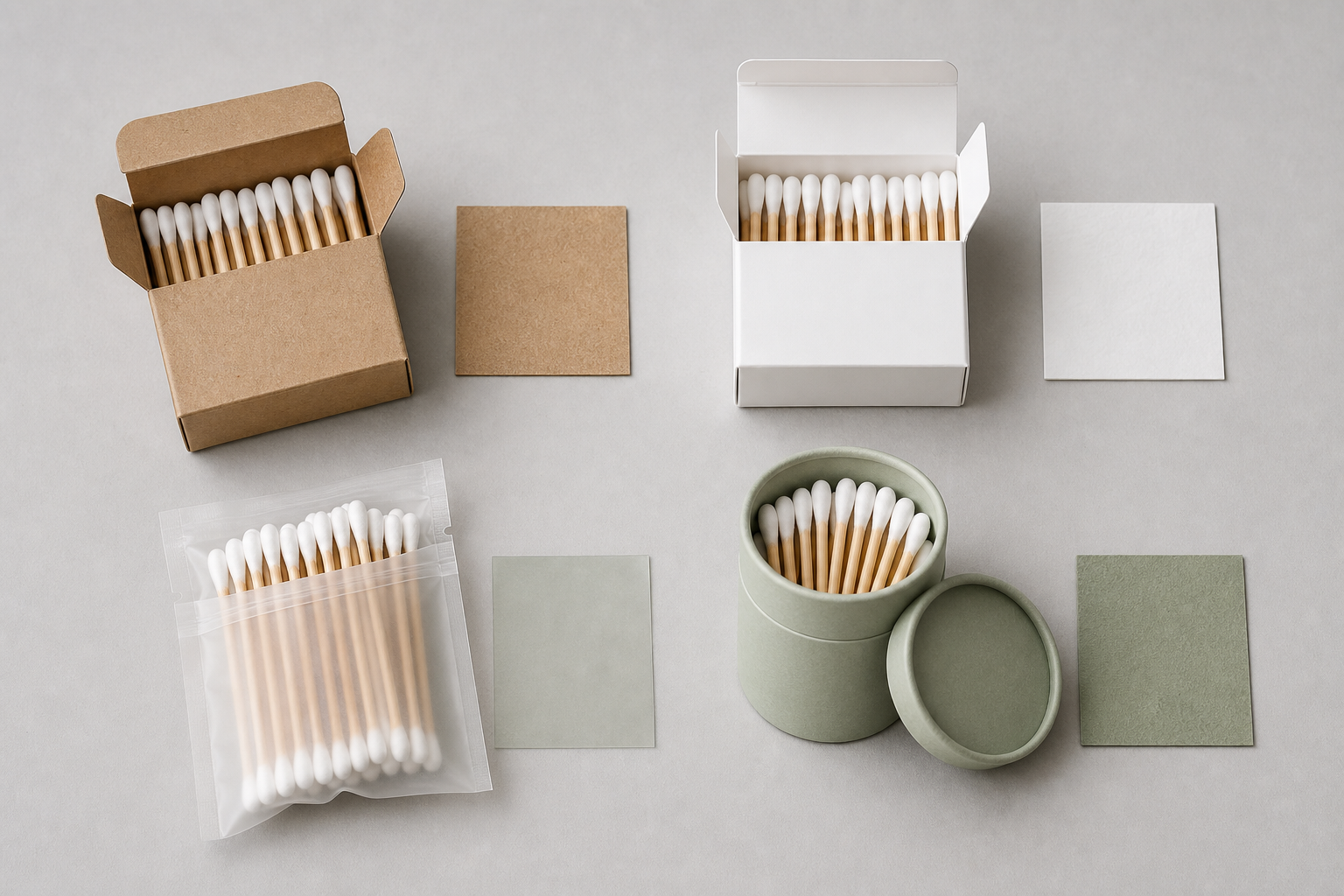
The five primary packaging materials for cotton buds packaging — kraft paper, white cardboard, corrugated board, PE bags, and PP containers — each offer distinct advantages in sustainability, cost, printability, and market positioning. Your material choice signals your brand values before the customer ever touches the product inside.
Material Comparison Matrix
| Material | Sustainability | Printability | Durability | Brand Positioning | Best For |
|---|---|---|---|---|---|
| Kraft paper box | Excellent (biodegradable, recyclable) | Good (natural texture limits color vibrancy) | Moderate | Eco-premium, natural | EU market, eco brands, Amazon FBA |
| White cardboard (SBS) | Good (recyclable) | Excellent (vibrant colors, smooth surface) | Good | Premium retail | Drugstore chains, gift sets |
| Corrugated cardboard | Good (recyclable) | Moderate | Excellent | Bulk/value | Warehouse clubs, B2B |
| PE poly bag | Poor (plastic, not biodegradable) | Limited (basic printing) | Low | Budget/economy | Price-sensitive markets |
| PP round container | Poor (plastic) | Good (label wrap or IML) | Excellent | Bathroom-friendly, reusable | Traditional retail (non-EU) |
Kraft Paper: The Dominant Choice for 2026
Kraft paper has emerged as the dominant sustainable packaging material for new cotton buds packaging brands entering the market. Its natural brown appearance immediately communicates sustainability without requiring additional messaging. The material is produced through the kraft pulping process, which yields strong, durable paper from wood fibers while using fewer chemicals than bleached alternatives. [1]
Key advantages of kraft paper as a packaging material:
- Biodegrades within 2–6 weeks in composting conditions
- Recyclable in standard municipal recycling streams
- Provides structural rigidity sufficient for 200–500 count packs
- Natural texture creates tactile differentiation on shelf
- Compatible with soy-based and water-based inks for eco-friendly printing
- Aligns with EU Single-Use Plastics Directive requirements
Limitations to consider: Kraft paper absorbs moisture more readily than coated cardboard, requiring inner liners or moisture-barrier coatings for humid climates. The natural brown color limits color reproduction — designs must work with the kraft background rather than against it.
White Cardboard (SBS): Premium Retail Positioning
Solid Bleached Sulfate (SBS) board delivers the highest print quality among paper-based options. Its smooth, white surface enables full-color CMYK printing with photographic accuracy, making it the preferred choice for brands that rely on visual impact and detailed graphics. Major retail chains often require SBS packaging for planogram consistency.
PE Bags: Budget Positioning
Polyethylene bags represent the lowest-cost OEM packaging option for cotton swabs, typically used for economy-tier products in price-sensitive markets. While cost-effective, PE bags are increasingly restricted in the EU and face growing consumer resistance in sustainability-conscious markets. They offer minimal branding surface area and no structural protection for the product.
Material Selection Guidance: Your target market determines your packaging materials choice. For EU markets, plastic-free options (kraft or cardboard) are effectively mandatory. For Amazon FBA, flat kraft boxes optimize fulfillment costs. For traditional retail, white cardboard maximizes shelf impact. Discuss material options with SwabMasters →
Sustainable Packaging Certifications for Cotton Swabs
FSC (Forest Stewardship Council) certification is the minimum recommended sustainable packaging standard for eco-positioned cotton swab brands, with 78% of global consumers recognizing the FSC logo — making it the most powerful sustainability signal you can add to your packaging. [2] Certifications provide third-party verification of environmental claims, protecting your brand from greenwashing accusations and building consumer trust.
Sustainable Packaging Certification Comparison
| Certification | Focus Area | Geographic Strength | Consumer Recognition | Cost to Obtain | Best For |
|---|---|---|---|---|---|
| FSC | Responsible forest management | Global | Very High (78%) | Moderate | All eco-brands (recommended minimum) |
| PEFC | Sustainable forest management | Europe, Asia-Pacific | High in EU | Moderate | EU-focused brands |
| SFI | Sustainable forestry | North America | Moderate (US/Canada) | Moderate | US/Canada-focused brands |
| OK Compost (TUV) | Home/industrial compostability | Europe | Growing | Higher | Premium eco brands |
| Cradle to Cradle | Circular economy design | Global | Moderate | High | Luxury eco brands |
How to Obtain FSC Certification for Your Packaging
FSC certification operates through a chain-of-custody system. Your packaging manufacturer must hold FSC Chain of Custody (CoC) certification to produce FSC-labeled packaging. As an OEM buyer, you do not need your own FSC certification — you need a manufacturer whose paper supply chain is FSC-certified.
Three FSC label types relevant to your packaging:
- FSC 100% — All fiber comes from FSC-certified forests (highest level)
- FSC Mix — A mixture of FSC-certified, recycled, and controlled wood (most common for packaging)
- FSC Recycled — Made entirely from recycled material (strong sustainability story)
When selecting a cotton swab manufacturer, verify their FSC CoC certificate number and confirm it covers the specific paper grades used for your packaging. SwabMasters maintains FSC CoC certification across our packaging supply chain, enabling all OEM clients to use FSC labeling without additional certification costs.
Additional Sustainability Claims
Beyond forest certifications, your product packaging can carry additional environmental claims:
- “Plastic-free” — Verifiable if no plastic components (including lamination, windows, or adhesives) are used
- “Compostable” — Requires third-party testing (EN 13432 for industrial, OK Compost HOME for home composting)
- “Made from recycled content” — Specify percentage (e.g., “Made from 80% post-consumer recycled fiber”)
- “Carbon neutral” — Requires lifecycle assessment and offset verification
Certification Tip: Start with FSC Mix certification (the most accessible level) and add compostability claims as your brand grows. Avoid unverified claims like “eco-friendly” without supporting certification — this constitutes greenwashing and may violate FTC Green Guides in the US. [3]
FDA Labeling Requirements for Cotton Swab Packaging
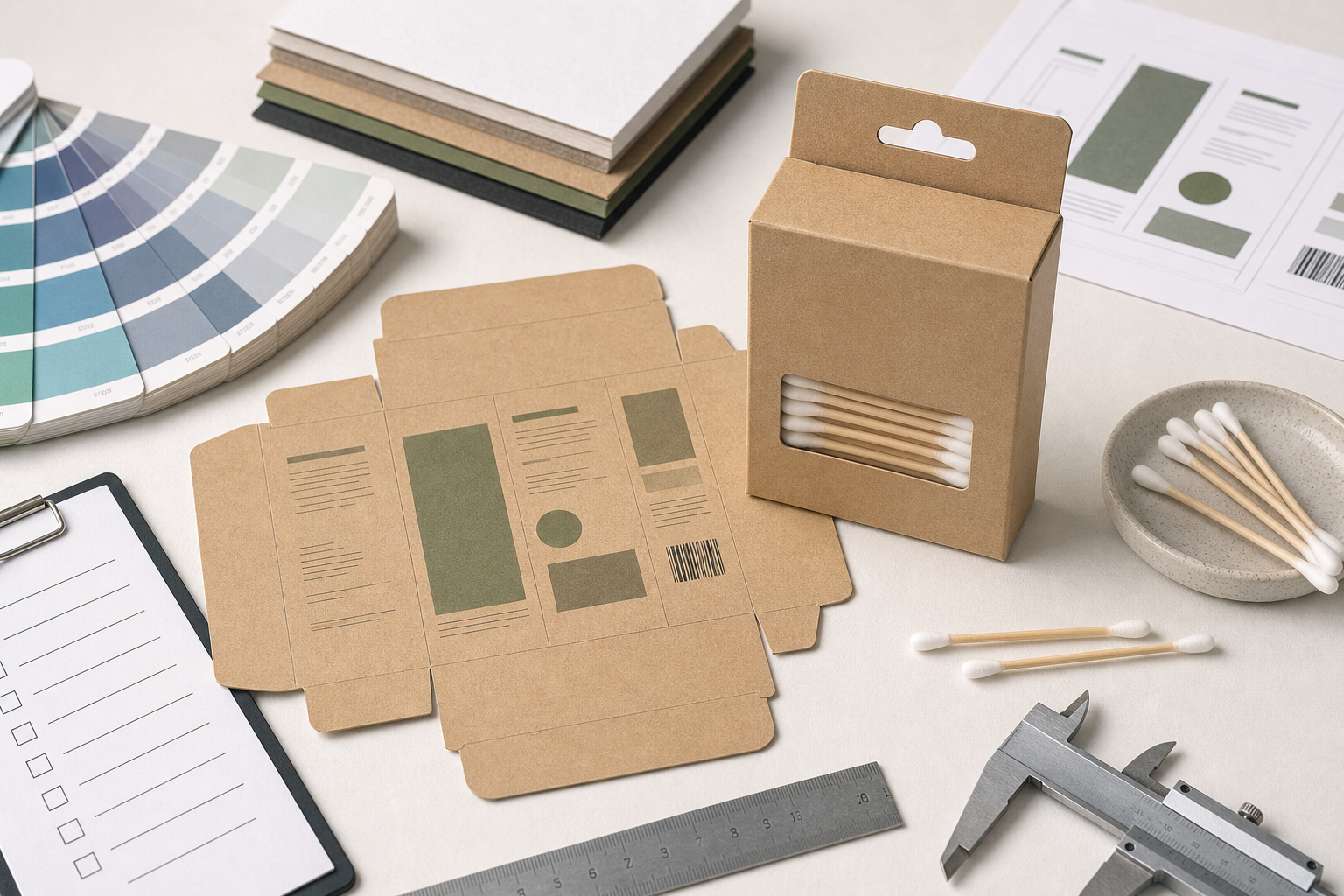
Cotton swabs sold in the United States must comply with FDA cosmetic labeling regulations under the FD&C Act and Fair Packaging and Labeling Act, requiring specific label elements including product identity, net quantity, manufacturer information, and ingredient declaration in prescribed formats and minimum type sizes. [4] Non-compliance can result in product seizure, import refusal, or warning letters.
Mandatory Label Elements (US Market)
| Element | Location | Requirements |
|---|---|---|
| Product name/identity | Principal Display Panel (PDP) | Must identify the nature or use of the product |
| Net quantity of contents | Bottom 30% of PDP | US customary units (oz) + metric; parallel to base |
| Manufacturer/distributor | Information panel | Full street address, city, state, ZIP |
| Ingredient declaration | Information panel | Descending order of predominance; min 1/16″ type |
| Country of origin | Any panel | Required for imported products (Tariff Act 1930) |
| Warning statements | Conspicuous location | If product may be hazardous when misused |
Type Size Requirements
FDA regulations specify minimum type sizes based on package surface area:
| Package Surface Area | Minimum Type Size (Ingredients) |
|---|---|
| 12 square inches or more | 1/16 inch (1.59 mm) |
| Less than 12 square inches | 1/32 inch (0.79 mm) |
For most standard boxes (200–500 count), the total surface exceeds 12 square inches of total surface area, requiring the larger 1/16 inch minimum type size for ingredient declarations.
Ingredient Declaration for Cotton Swabs
Cotton swabs classified as cosmetics must list ingredients in descending order of predominance. A typical ingredient declaration for bamboo cotton swabs reads:
Ingredients: Cotton (Gossypium), Bamboo (Bambusoideae)
For cotton swabs with additional treatments (e.g., iodine-tipped, aloe-infused), all active and inactive ingredients must be declared. If the product is also classified as a drug (e.g., antiseptic swabs), active ingredients must be listed separately before cosmetic ingredients.
Medical-Grade Cotton Swab Labeling
Cotton swabs intended for medical use (specimen collection, wound care) fall under FDA medical device regulations rather than cosmetic rules. These require:
- FDA 510(k) clearance or registration
- Device listing number
- Sterility indicators (if applicable)
- Lot/batch number for traceability
- Expiration date
- Storage conditions
For detailed import requirements, see our guide: How to Import Cotton Swabs from China: HS Codes, FDA Regulations & Customs Clearance.
EU Regulations and Single-Use Plastics Directive
The EU Single-Use Plastics Directive (EU 2019/904), effective since July 3, 2021, explicitly bans plastic cotton bud sticks across all 27 EU member states — making plastic-free packaging design not just a branding choice but a legal requirement for any cotton swab brand selling in Europe. [5] This regulation has fundamentally reshaped packaging design for cotton swabs across the global market.
What the Directive Requires
| Requirement | Impact on Packaging Design |
|---|---|
| Plastic stick ban | Sticks must be bamboo, paper, or wood |
| Marking requirements | Packaging must inform about plastic content and disposal |
| Extended Producer Responsibility | Manufacturers contribute to waste management costs |
| Consumption reduction measures | Applies to packaging containing plastic components |
EU Cosmetic Regulation 1223/2009 Labeling
Cotton swabs sold as cosmetic products in the EU must comply with Regulation 1223/2009, which requires: [6]
- Responsible Person — Name and address of the EU-based responsible person
- Country of origin — Required for products manufactured outside the EU
- Nominal content — Weight or volume at time of packaging
- Ingredients list — Using INCI (International Nomenclature of Cosmetic Ingredients) nomenclature
- Batch number — For traceability and recall purposes
- Function of the product — Unless obvious from presentation
- Period After Opening (PAO) — If shelf life exceeds 30 months (typically not applicable to cotton swabs)
Designing for Multi-Market Compliance
OEM buyers selling in both US and EU markets face a design challenge: accommodating two different regulatory frameworks on a single package. The most efficient approach is designing a “universal” label layout that satisfies both markets:
| Panel | US Requirements | EU Requirements | Universal Solution |
|---|---|---|---|
| Front (PDP) | Product name, net quantity | Product name, nominal content | Combined with dual units |
| Back | Ingredients (INCI optional) | Ingredients (INCI required) | Use INCI for both |
| Side 1 | Manufacturer address | Responsible Person address | List both |
| Side 2 | Country of origin | Country of origin + batch | Combined panel |
Compliance Note: If you sell in the EU, your packaging must be completely plastic-free (including lamination films and adhesives) to avoid potential enforcement issues. SwabMasters offers fully plastic-free packaging options using soy-based inks, water-based adhesives, and uncoated kraft paper. Request EU-compliant packaging samples →
Packaging Dimensions and Size Optimization
Packaging dimensions directly impact fulfillment costs, shipping efficiency, and retail shelf space allocation — with Amazon FBA size tier boundaries creating hard cost thresholds that make dimensional optimization one of the highest-ROI packaging decisions an OEM buyer can make. Designing your package even 1 inch too large can push you into a higher fee tier, permanently eroding your margins.
Amazon FBA Size Tier Boundaries
| Size Tier | Max Dimensions | Max Weight | Impact on Your Packaging |
|---|---|---|---|
| Small Standard | 15″ × 12″ × 0.75″ | 12 oz | Lowest fees — ideal target for flat boxes |
| Large Standard | 18″ × 14″ × 8″ | 20 lb | Moderate fees — round containers fall here |
| Large Bulky | 59″ × 33″ × 33″ | 50 lb | High fees — avoid for individual units |
Recommended Dimensions by Product Configuration
| Product | Pack Count | Recommended Box Size | Size Tier |
|---|---|---|---|
| Bamboo cotton buds (flat box) | 200 ct | 8″ × 3.5″ × 0.6″ | Small Standard |
| Bamboo cotton buds (flat box) | 400 ct | 14″ × 4″ × 0.7″ | Small Standard |
| Bamboo cotton buds (flat box) | 500 ct | 14.5″ × 4.5″ × 0.7″ | Small Standard |
| Paper-stick swabs (round container) | 200 ct | 3″ diameter × 4″ height | Large Standard |
| Precision tip swabs (slim box) | 100 ct | 6″ × 2″ × 0.5″ | Small Standard |
Structural Design Principles
Rule 1: Design flat, not tall. Flat rectangular boxes maximize the Small Standard tier qualification while providing ample surface area for branding. Round containers and tall boxes push into Large Standard, increasing per-unit fulfillment costs by 20–25%.
Rule 2: Account for poly-bag overhang. Amazon requires most products to be poly-bagged. The bag must not extend more than 3 inches beyond the product. Factor this into your dimensional planning.
Rule 3: Design for case-pack efficiency. Your individual package dimensions should tile efficiently into standard shipping cartons (typically 20″ × 14″ × 10″ or similar). Poor case-pack efficiency increases inbound shipping costs.
Rule 4: Maintain structural integrity. Kraft paper boxes for 400+ count packs require minimum 350gsm board weight to prevent crushing during fulfillment. Consider internal dividers or reinforced corners for premium products.
For detailed MOQ and packaging configuration guidance, see: Cotton Swab MOQ Guide: Minimum Order Quantities Explained.
Branding Strategy for Cotton Swab Packaging
Effective cotton swab packaging branding communicates three things within 3 seconds of visual contact: what the product is made of (material story), how many are inside (value proposition), and why this brand is different (positioning statement). In a category where consumers make purchase decisions in under 5 seconds on shelf or while scrolling Amazon search results, your packaging must work as a silent salesperson.
The Hierarchy of Packaging Information
Design your cotton swab packaging information hierarchy in this priority order:
| Priority | Element | Purpose | Design Treatment |
|---|---|---|---|
| 1 | Brand logo | Recognition and trust | Largest element, top-center or top-left |
| 2 | Material callout | Differentiation | Bold text: “BAMBOO” or “100% ORGANIC COTTON” |
| 3 | Count indicator | Value communication | Large numeral: “400” with “cotton buds” below |
| 4 | Key certification | Trust signal | FSC logo, organic badge near brand logo |
| 5 | Product visual | Quality assurance | Window, illustration, or product photo |
| 6 | Benefit statement | Emotional connection | “Plastic-free. Planet-friendly.” |
Color Strategy for Your Packaging
Color choices in sustainable packaging for cotton swabs follow predictable patterns that you can either align with or deliberately disrupt:
| Positioning | Dominant Colors | Rationale |
|---|---|---|
| Eco/natural | Earth tones, greens, unbleached kraft | Signals sustainability, natural origin |
| Premium/luxury | Black, gold, deep navy | Signals quality, exclusivity |
| Clinical/medical | White, blue, silver | Signals sterility, professionalism |
| Playful/youth | Bright pastels, coral, mint | Signals approachability, modern |
| Value/economy | White with primary colors | Signals affordability, clarity |
Differentiation strategy: If your competitors all use green packaging (common in the eco segment), consider using a distinctive alternative — deep navy with gold accents, or matte black with white typography — to stand out while still communicating premium quality.
Typography and Readability
Typography on cotton buds packaging must balance brand personality with regulatory compliance:
- Brand name: Display typeface, bold weight, minimum 14pt equivalent
- Product descriptor: Clean sans-serif, medium weight, minimum 10pt
- Count number: Bold, high-contrast, minimum 24pt equivalent
- Regulatory text: Clean sans-serif, regular weight, minimum 6pt (FDA minimum 1/16″)
- Certification text: Per certification body guidelines (FSC has specific size requirements)
Packaging as Photography Subject
For e-commerce brands, packaging must photograph well. Design considerations specific to product photography:
- High contrast between text and background (readable at Amazon thumbnail size — 150×150 pixels)
- Avoid metallic finishes that create glare in studio lighting
- Include a clean “hero face” — one panel designed specifically as the primary product image
- Consider how the package looks at 45-degree angle (common lifestyle photography angle)
Brand Development Support: SwabMasters provides in-house packaging design services including structural engineering, graphic design templates, and print-ready file preparation. We can work from your brand guidelines or help develop packaging concepts from scratch. Start your packaging design project →
Packaging Design for Amazon and E-commerce
Amazon’s A9/COSMO algorithm weighs main image click-through rate as a primary ranking factor, making your OEM packaging design a direct SEO variable — packages that photograph well and communicate clearly at thumbnail size generate higher CTR, better ranking, and more sales. [7] For e-commerce brands, packaging is not just a container — it is your primary marketing asset.
Amazon Main Image Requirements
Your product packaging must comply with Amazon’s product image requirements while maximizing visual impact:
| Requirement | Amazon Rule | Optimization Tip |
|---|---|---|
| Background | Pure white (RGB 255,255,255) | Design packaging with clean edges for easy cutout |
| Product fill | Must fill 85%+ of image frame | Flat boxes photograph larger than round containers |
| Text on package | Allowed (it’s part of the product) | Make brand name and count readable at 150px |
| Props/lifestyle | Main image: product only | Design packaging to be visually complete without context |
| Resolution | Minimum 1000px on longest side | Ensure fine text is sharp at high resolution |
Packaging Elements That Increase Conversion
Analysis of top-performing cotton swab listings on Amazon reveals consistent packaging design patterns: [8]
- Visible product count — Large, bold number (e.g., “400”) immediately communicates value
- Material identification — “BAMBOO” or “ORGANIC” prominently displayed
- Certification badges — FSC, cruelty-free, or vegan logos visible at thumbnail size
- Color differentiation — Distinct from Q-tips blue and store-brand white
- Clean front panel — Minimal clutter, maximum readability
Unboxing Experience Design
For subscription and repeat-purchase products (cotton swabs have 35%+ Subscribe & Save rates on Amazon), the unboxing experience drives review sentiment and repeat purchases:
- Inner print: Add a thank-you message or usage tip on the inside of the box lid
- Product reveal: Design the opening mechanism to showcase the cotton tips neatly arranged
- Insert card: Include a brand story card with QR code linking to your website
- Scent: Some premium brands add a subtle natural scent (lavender, eucalyptus) to the packaging interior
Multi-Pack and Bundle Packaging
For multi-pack offerings (common on Amazon for cotton swabs), consider:
- Sleeve packaging: Individual boxes held together by a printed kraft sleeve
- Variety pack box: Single larger box with compartments for different swab types
- Subscription box: Designed for repeat delivery with “Month 1, Month 2” indicators
Common Packaging Design Mistakes to Avoid
The most expensive packaging design mistake is designing for aesthetics without verifying regulatory compliance and dimensional requirements — resulting in costly redesigns, shipment rejections, or Amazon listing suppression after production has already begun. Learning from others’ errors saves both time and money.
Top 10 Packaging Design Mistakes
| # | Mistake | Consequence | Prevention |
|---|---|---|---|
| 1 | Exceeding Amazon size tier by 1–2 inches | 20–25% higher fulfillment fees permanently | Verify dimensions against tier boundaries before finalizing |
| 2 | Missing FDA ingredient declaration | Import refusal, product seizure | Use FDA labeling checklist before print approval |
| 3 | Using plastic lamination for EU market | Non-compliant with SUP Directive | Specify water-based coatings for EU packaging |
| 4 | Unverified sustainability claims | FTC enforcement, consumer backlash | Only claim what you can certify (FSC, compostable, etc.) |
| 5 | Type size below FDA minimum | Misbranding violation | Verify all text meets 1/16″ minimum (or 1/32″ for small packages) |
| 6 | Designing without photography in mind | Poor Amazon main image, low CTR | Test packaging design at 150×150 pixel thumbnail |
| 7 | Ignoring case-pack efficiency | Higher inbound shipping costs | Design individual units to tile into standard cartons |
| 8 | Insufficient board weight | Crushing during fulfillment | Minimum 350gsm for 400+ count packs |
| 9 | No batch/lot number space | Traceability failure, recall difficulty | Include designated area for variable printing |
| 10 | Single-market design for multi-market sales | Redesign costs, compliance delays | Design universal layout from the start |
The Redesign Cost Trap
Packaging redesigns after initial production are disproportionately expensive because they require new printing plates, updated structural dies, and often new material sourcing. The most cost-effective approach is investing in thorough design validation before production:
Pre-production validation checklist:
- Regulatory compliance review (FDA + target market regulations)
- Dimensional verification against fulfillment requirements
- Structural integrity testing (drop test, compression test)
- Print color proofing (digital proof + physical sample)
- Photography test (shoot sample packaging, verify thumbnail readability)
- Case-pack efficiency calculation
Avoid costly mistakes: SwabMasters provides pre-production packaging validation as part of our OEM service, including regulatory compliance review, dimensional optimization, and photography testing — before you commit to production. Get your packaging design validated →
Frequently Asked Questions
What packaging materials are best for cotton swabs?
The best cotton swab packaging material depends on your target market and positioning. Kraft paper boxes are ideal for eco-friendly brands (biodegradable, recyclable, strong brand storytelling). White cardboard (SBS) boxes with printed graphics suit premium retail positioning with maximum color vibrancy. PE bags offer the lowest cost for budget products but face increasing restrictions. For the EU market, plastic-free packaging is mandatory for cotton bud sticks under the Single-Use Plastics Directive (EU 2019/904). For Amazon FBA, flat kraft paper boxes that fit within the Small Standard size tier (max 15″ × 12″ × 0.75″) optimize fulfillment costs while supporting eco-premium branding.
What are the FDA labeling requirements for cotton swab packaging?
Cotton swabs classified as cosmetics under FDA regulations must comply with FD&C Act and Fair Packaging and Labeling Act requirements. [4] Mandatory label elements include: product identity/name on the principal display panel, net quantity of contents (in both US customary and metric units), name and address of manufacturer or distributor, ingredient declaration in descending order of predominance (minimum 1/16″ type size for packages over 12 square inches), and country of origin for imported products. Medical-grade swabs require additional FDA device registration and 510(k) clearance information.
How does the EU Single-Use Plastics Directive affect cotton swab packaging?
The EU Single-Use Plastics Directive (EU 2019/904), effective since July 2021, bans plastic cotton bud sticks across all EU member states. [5] Cotton swabs sold in the EU must use non-plastic stick materials (bamboo, paper, or wood). While the directive specifically targets the stick material, brands selling in the EU increasingly adopt fully plastic-free packaging — including avoiding plastic lamination films, plastic windows, and plastic-based adhesives — to align with the regulation’s sustainability intent and growing consumer expectations for plastic-free products.
What sustainable packaging certifications should cotton swab brands pursue?
FSC (Forest Stewardship Council) certification is the recommended minimum for eco-positioned cotton swab brands, as it has the highest consumer recognition globally (78% awareness). [2] For EU-focused brands, PEFC certification provides strong regional recognition. SFI certification is most relevant for North American markets. For brands making compostability claims, OK Compost (TUV) certification provides third-party verification. Start with FSC Mix (the most accessible level) and add additional certifications as your brand grows and sustainability claims expand.
What packaging size works best for cotton swabs on Amazon FBA?
For Amazon FBA, design cotton swab packaging to fit within the Small Standard size tier (maximum 15″ × 12″ × 0.75″, under 12 oz) to qualify for the lowest fulfillment fee bracket. A flat rectangular kraft paper box measuring approximately 14″ × 4″ × 0.7″ works well for 400-count bamboo cotton buds. This configuration qualifies for Small Standard fees while providing enough surface area for branding, ingredient lists, and certification logos. Avoid round containers or tall boxes that push into the Large Standard tier, which increases per-unit fulfillment costs by 20–25%.
How much does custom cotton swab packaging design cost?
Custom cotton swab packaging costs vary based on design complexity, material choice, print specifications, and order volume. The cost structure includes one-time investments (graphic design, structural engineering, printing plates/dies) and recurring per-unit costs (material, printing, finishing). Key factors that influence cost: number of print colors (spot colors vs CMYK), material grade (virgin kraft vs recycled), surface treatments (matte lamination, spot UV, embossing), and order quantity (volume discounts typically range 15–40%). Contact your manufacturer for exact pricing based on your specific design requirements and order volume.
What information must appear on cotton swab packaging for international markets?
For the US market (FDA): product name, net quantity, manufacturer/distributor name and address, ingredient declaration, and country of origin. For the EU market (Regulation 1223/2009): responsible person name and address, country of origin, nominal content, ingredients in INCI nomenclature, batch number, and function description. [4] [6] For both markets: relevant certification logos (FSC, organic), barcode (UPC for US, EAN for EU), and safety warnings if applicable. Multi-market packaging often uses bilingual labeling and a universal layout to serve multiple regions with a single SKU, reducing design and inventory costs.
What are the most effective branding elements for cotton swab packaging?
The most effective branding elements follow a clear visual hierarchy: (1) brand logo prominently placed on the front panel, (2) material callout as primary messaging (“BAMBOO” or “100% ORGANIC COTTON”), (3) count indicator in large bold numerals, (4) certification badges (FSC, cruelty-free) near the brand logo, and (5) a benefit statement connecting to consumer values (“Plastic-free. Planet-friendly.”). For Amazon specifically, packaging must be readable at thumbnail size (150×150 pixels) — high contrast between text and background, clean front panel, and distinctive color differentiation from competitors.
Start Your Packaging Design Project
Packaging design is where brand strategy meets manufacturing reality. The decisions you make about materials, dimensions, certifications, and visual design will directly impact your regulatory compliance, fulfillment costs, conversion rates, and brand perception for the lifetime of your product.
Your packaging design checklist:
| Step | Action | Key Decision |
|---|---|---|
| 1 | Define target markets | US only, EU only, or multi-market? |
| 2 | Choose material | Kraft, cardboard, or mixed? |
| 3 | Set dimensions | Optimize for Amazon size tier or retail shelf? |
| 4 | Select certifications | FSC, PEFC, compostable? |
| 5 | Design brand elements | Logo, colors, typography, hierarchy |
| 6 | Verify compliance | FDA, EU 1223/2009, SUP Directive |
| 7 | Test and validate | Photography test, structural test, compliance review |
Ready to design your cotton swab packaging? Contact SwabMasters for a free packaging consultation. We provide end-to-end OEM packaging services — from structural design and material selection to print-ready file preparation and pre-production validation. Our in-house design team has created packaging for 200+ cotton swab brands across 40+ countries.
For comprehensive information on cotton swab types and applications, visit our product guide.
References
- Packaging Gateway. “The Rise of Kraft Paper in Eco-Conscious Packaging.” packaging-gateway.com, October 2025.
- FSC. “Global Consumer Research: FSC Label Recognition.” fsc.org, 2024.
- U.S. Federal Trade Commission. “Guides for the Use of Environmental Marketing Claims (Green Guides).” ftc.gov, 16 CFR Part 260.
- U.S. Food and Drug Administration. “Summary of Cosmetics Labeling Requirements.” fda.gov, November 2025.
- European Commission. “Single-Use Plastics Directive (EU 2019/904).” environment.ec.europa.eu, 2019.
- European Commission. “EU Cosmetic Regulation 1223/2009.” eur-lex.europa.eu, 2009.
- Amazon Seller Central. “Product Image Requirements.” sellercentral.amazon.com, 2026.
- AMZChart. “Cotton Swabs Category Listing Analysis.” amzchart.com, 2026.