By Mike Zhang, Manufacturing Director at SwabMasters | Last Updated: June 2026
Importing cotton swabs from China can save you 40–60% compared to domestic sourcing — but one wrong HS code or a missing compliance document can get your entire shipment detained at the port. This guide breaks down everything you need to know: the exact tariff classifications, FDA requirements, UFLPA cotton tracing rules, and a step-by-step customs clearance checklist. Whether you are an Amazon FBA seller importing your first container or an established distributor scaling your supply chain, this article will help you avoid costly mistakes.
What HS Code Do Cotton Swabs Fall Under?
The Harmonized System (HS) code determines how much duty you pay and which regulations apply to your shipment. Getting this wrong is the single most expensive mistake importers make.
Cotton swabs are classified under HS Code 5601.21.0090 in the United States Harmonized Tariff Schedule (HTSUS). This heading covers “Wadding of textile materials and articles thereof; textile fibers, not exceeding 5 mm in length (flock), textile dust and mill neps: Wadding of textile materials and articles thereof: Of cotton: Other.”
This classification applies regardless of whether the cotton swab has a plastic stick, paper stick, bamboo stick, or wooden stick. The determining factor is the cotton tip — not the handle material. Cotton pads and cotton rounds also fall under this same HS code.
| Product Type | HS Code (USA) | HS Code (EU) | Description |
| Cotton swabs (all stick types) | 5601.21.0090 | 5601.21.90 | Wadding articles, of cotton, other |
| Cotton pads / rounds | 5601.21.0090 | 5601.21.90 | Wadding articles, of cotton, other |
| Medical cotton tipped applicators (sterile) | 5601.21.0090 | 5601.21.10 | Wadding articles, of cotton, medical |
| Iodine/antiseptic swab sticks | 3004.90.9290 | 3004.90.00 | Medicaments, put up for retail sale |
One critical distinction: if your cotton swabs are pre-saturated with antiseptic solution (such as povidone-iodine or chlorhexidine), they may be reclassified under HS 3004 as medicaments rather than textile wadding. This changes both the duty rate and the regulatory requirements significantly. Always confirm with your customs broker before shipping.
Pro Tip from SwabMasters: We provide the correct HS code classification on every commercial invoice and packing list. Our export documentation team has processed over 3,000 shipments without a single classification dispute at customs.

Cotton Swab Import Duty Rates: What You Will Actually Pay
Understanding the total landed duty is essential for calculating your true cost of goods. Many first-time importers are shocked to discover that the headline duty rate is only part of the story.
The base MFN (Most Favored Nation) duty rate for cotton swabs from China under HS 5601.21.0090 is 3.6% ad valorem as of 2026. However, due to the ongoing Section 301 trade actions, an additional 25% tariff applies to this product category when imported from China.
| Duty Component | Rate | Legal Basis | Notes |
| Base MFN duty | 3.6% | HTSUS 5601.21.0090 | Applied to declared customs value |
| Section 301 tariff | 25.0% | 9903.88.03 | Additional duty on China-origin goods |
| Total effective duty | 28.6% | — | Applied to FOB or CIF value |
| Merchandise Processing Fee | 0.3464% | 19 USC 58c | Min $31.67, max $614.35 per entry |
| Harbor Maintenance Fee | 0.125% | 26 USC 4461 | Ocean shipments only |
For a practical example: if you import a 20-foot container of cotton swabs with a declared FOB value of $15,000, your total duty payment would be approximately $4,290 (28.6% × $15,000), plus the MPF of approximately $52 and HMF of approximately $19. Your total customs charges would be roughly $4,361 — adding about 29% to your product cost before freight and handling.
SwabMasters Insight: “Many of our clients initially underestimate the Section 301 impact. We help buyers optimize their product mix — for example, bamboo-stick swabs with synthetic tips may qualify for a different HS code with lower total duties. Contact our trade compliance team for a free duty optimization consultation.”
— Mike Zhang, Manufacturing Director

FDA Regulations for Importing Cotton Swabs
The FDA regulatory pathway depends entirely on the intended use of your cotton swabs. Consumer-use and medical-use products face completely different requirements.
Consumer-use cotton swabs (for cosmetic application, ear cleaning, arts and crafts, household cleaning) are not regulated as medical devices by the FDA. They fall under the Consumer Product Safety Commission (CPSC) jurisdiction instead. No FDA registration, no 510(k) submission, and no prior notice is required for consumer cotton swabs.
Medical-use cotton tipped applicators are classified as Class I medical devices under FDA Product Code KXF (non-sterile) or KXG (sterile), regulated under 21 CFR 880.6025. While they are exempt from 510(k) premarket notification, the following requirements still apply:
| Requirement | Consumer Swabs | Medical Swabs (Non-Sterile) | Medical Swabs (Sterile) |
| FDA Establishment Registration | Not required | Required (manufacturer + importer) | Required |
| Device Listing | Not required | Required (Product Code KXF) | Required (Product Code KXG) |
| 510(k) Submission | Not required | Exempt | Exempt |
| Quality System Regulation (QSR/cGMP) | Not required | Required (21 CFR 820) | Required |
| Medical Device Reporting (MDR) | Not required | Required | Required |
| Labeling Requirements | CPSC general | 21 CFR 801 | 21 CFR 801 + sterility claims |
| US Agent Required (foreign manufacturer) | No | Yes | Yes |
| FDA Prior Notice for Import | No | No (unless food-contact) | No |
If you are importing medical-grade cotton swabs, your Chinese manufacturer must have an active FDA Establishment Registration with a designated US Agent. At SwabMasters, we maintain current FDA registration (Registration Number available upon request) and can supply the necessary documentation for your customs entry.
UFLPA Compliance: The Cotton Origin Challenge
The Uyghur Forced Labor Prevention Act (UFLPA), effective June 21, 2022, created a rebuttable presumption that all goods produced in China’s Xinjiang Uyghur Autonomous Region — or by entities on the UFLPA Entity List — are made with forced labor and are therefore prohibited from entering the United States.
Cotton is one of the priority enforcement sectors under UFLPA. Since Xinjiang historically produced approximately 85% of China’s cotton output, this law has massive implications for anyone importing cotton-containing products from China — including cotton swabs and cotton pads.
If CBP (Customs and Border Protection) suspects your cotton swabs contain Xinjiang-origin cotton, your shipment will be detained and you will need to provide “clear and convincing evidence” that the cotton was not produced with forced labor. This is an extremely high evidentiary standard.
What documentation you need to prove UFLPA compliance:
Your supply chain tracing documentation should establish a complete chain of custody from the raw cotton source to the finished product. At minimum, CBP expects the following evidence package: purchase orders and invoices for raw cotton showing the specific farm or gin of origin; certificates of origin from the cotton supplier identifying the province (must be outside Xinjiang); production records showing the cotton processing pathway from bale to finished swab; and third-party audit reports or certifications (such as the Better Cotton Initiative or OEKO-TEX) that verify the supply chain.
SwabMasters Compliance Guarantee: All SwabMasters cotton is sourced exclusively from Hubei and Shandong provinces. We maintain full traceability documentation from cotton gin to finished product, and provide a UFLPA Compliance Package with every shipment — including cotton origin certificates, supplier audit reports, and chain-of-custody records. Zero detentions in 3+ years since UFLPA enforcement began.
EU Import Requirements: CE Marking and MDR Compliance
For importers targeting the European market, the regulatory landscape differs significantly from the United States. The key distinction is between consumer products and medical devices under the Medical Device Regulation (MDR 2017/745).
Consumer cotton swabs and cotton pads entering the EU must comply with the General Product Safety Directive (2001/95/EC) and REACH Regulation (EC 1907/2006) for chemical safety. No CE marking is required for standard consumer cotton swabs. The import duty rate is 3.8% ad valorem under EU HS code 5601.21.90, with no additional punitive tariffs equivalent to Section 301.
Medical cotton swabs require CE marking under MDR 2017/745. As Class I medical devices, they require a Declaration of Conformity, technical documentation, and registration with the competent authority in the EU member state where the product is first placed on the market. An Authorized Representative (EC REP) based in the EU is mandatory for non-EU manufacturers.
| Requirement | USA (Consumer) | USA (Medical) | EU (Consumer) | EU (Medical) |
| Import duty | 28.6% (incl. 301) | 28.6% (incl. 301) | 3.8% | 3.8% |
| Product registration | None | FDA Establishment | None | CE marking + Notified Body |
| Safety standard | CPSC general | 21 CFR 820 | GPSD + REACH | MDR 2017/745 |
| Supply chain tracing | UFLPA required | UFLPA required | Due diligence | Due diligence |
| Local representative | None | US Agent | None | EC REP |
Step-by-Step Customs Clearance Process for Cotton Swabs
Customs clearance for cotton swabs follows a predictable sequence. Understanding each step helps you avoid delays that can cost $150–$500 per day in port storage fees (demurrage).
Step 1: Pre-Shipment Documentation (2–3 weeks before shipping). Before your goods leave China, ensure your supplier provides a complete documentation package. The commercial invoice must show the correct HS code (5601.21.0090), unit price, total value, country of origin (China), and product description matching the tariff classification. The packing list should detail carton counts, gross/net weights, and dimensions. For ocean freight, your freight forwarder must file the Importer Security Filing (ISF or “10+2”) at least 24 hours before the vessel is loaded at the Chinese port — late filing incurs a $5,000 penalty per violation.
Step 2: Customs Entry Filing (upon vessel arrival). Your customs broker files the entry (CBP Form 7501) within 15 calendar days of the vessel’s arrival. You need an active Customs Bond — either a single-entry bond (approximately $50–$100) or a continuous bond (approximately $500–$1,000/year, recommended for regular importers). The bond amount must be at least equal to the total duties, taxes, and fees for the entry.
Step 3: CBP Review and Examination. CBP may select your shipment for examination based on risk assessment algorithms. Cotton products from China face elevated scrutiny due to UFLPA enforcement. If selected, CBP may request your UFLPA compliance documentation. Average examination adds 3–5 business days to clearance time.
Step 4: Duty Payment and Release. Once CBP clears your entry, duties are assessed and must be paid within 10 working days. After payment confirmation, CBP releases the cargo for delivery. Total clearance time for a routine, non-examined shipment is typically 2–5 business days from vessel arrival.
Step 5: Post-Entry Compliance. CBP may audit your entry up to 5 years after importation. Maintain all import records, invoices, and compliance documentation for at least 5 years. Discrepancies discovered during audit can result in penalties of up to 4x the unpaid duties.
Required Documents Checklist for Cotton Swab Imports
Having your documentation complete and accurate before shipment is the single best way to prevent customs delays. The following table summarizes every document you need, organized by when it is required in the process.
| Document | When Needed | Who Provides | Purpose |
| Commercial Invoice | Pre-shipment | Supplier (SwabMasters) | Declares value, origin, HS code |
| Packing List | Pre-shipment | Supplier | Details carton count, weights, dimensions |
| Bill of Lading (B/L) | At shipping | Freight forwarder / carrier | Title document for ocean cargo |
| Certificate of Origin | Pre-shipment | Supplier or chamber of commerce | Confirms country of manufacture |
| Cotton Origin Certificate | Pre-shipment | Cotton supplier / third-party auditor | UFLPA compliance — proves non-Xinjiang origin |
| ISF (10+2) Filing | 24hrs before loading | Customs broker / importer | Security filing for ocean shipments |
| Customs Bond | Before entry filing | Surety company via broker | Guarantees duty payment to CBP |
| CBP Form 7501 | Upon arrival | Customs broker | Formal entry summary |
| SGS/Intertek Test Report | Pre-shipment (recommended) | Third-party lab | Material safety and quality verification |
| FDA Registration Proof | Before entry (medical only) | Manufacturer | Confirms FDA establishment registration |
| UFLPA Compliance Package | If CBP requests | Supplier (SwabMasters) | Supply chain tracing documentation |
SwabMasters Service: We prepare a complete export documentation package for every order — including commercial invoice with correct HS code, detailed packing list, certificate of origin, cotton traceability certificate, and SGS test reports. Our documentation has a 100% first-pass clearance rate with US Customs.
Common Import Mistakes That Get Shipments Detained
After helping clients navigate over 3,000 import shipments, we have seen the same costly mistakes repeated. Here are the top five errors and how to avoid them.
Mistake #1: Wrong HS Code Classification. Using a generic “cotton products” code instead of the specific 5601.21.0090 can trigger an automatic review. Worse, if you accidentally use a code with a higher duty rate, you overpay. If you use one with a lower rate, you face penalties when audited. Always confirm the classification with your customs broker before the first shipment.
Mistake #2: Missing UFLPA Documentation. CBP has detained thousands of cotton-containing shipments since June 2022. If you cannot prove your cotton does not originate from Xinjiang within the CBP-specified timeframe (typically 30 days), the goods are either re-exported or destroyed — at your expense. Demand cotton origin certificates from your supplier before placing the order, not after the shipment arrives.
Mistake #3: Undervaluing the Shipment. Some importers declare a lower value to reduce duties. CBP uses sophisticated pricing databases and will flag values that fall below expected ranges for cotton swabs ($0.005–$0.02 per piece FOB). Penalties for intentional undervaluation can reach 4x the unpaid duties plus potential criminal charges.
Mistake #4: Late ISF Filing. The Importer Security Filing must be transmitted at least 24 hours before the vessel is loaded in China. Late filing results in a $5,000 liquidated damages claim per violation — and CBP actively enforces this. Ensure your customs broker has all information at least 72 hours before the vessel’s estimated departure.
Mistake #5: Importing Medical Swabs Without FDA Registration. If your product labeling or marketing materials mention “medical,” “clinical,” “specimen collection,” or “wound care,” CBP may classify it as a medical device regardless of your intended HS code. Ensure your manufacturer has active FDA Establishment Registration before shipping any product that could be interpreted as medical-use.
How to Calculate Your Total Landed Cost
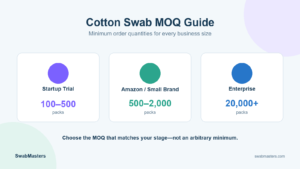
Order volume directly affects product cost, packaging efficiency, and freight allocation. Review our cotton swab MOQ and minimum order requirements before calculating your landed cost and import budget.
Understanding your true landed cost is critical for pricing your products competitively. Here is a complete cost breakdown for a typical 20-foot container of cotton swabs imported from China to the US West Coast.
| Cost Component | Amount (USD) | % of Total | Notes |
| Product cost (FOB Shenzhen) | $15,000 | 55.8% | 500,000 pcs × $0.03/pc |
| Ocean freight (20ft FCL) | $2,200 | 8.2% | China to Los Angeles, 2026 rate |
| Marine insurance | $150 | 0.6% | 0.5% of CIF value |
| Base duty (3.6%) | $540 | 2.0% | On FOB value |
| Section 301 tariff (25%) | $3,750 | 14.0% | On FOB value |
| Merchandise Processing Fee | $52 | 0.2% | 0.3464% of value |
| Harbor Maintenance Fee | $22 | 0.1% | 0.125% of value, ocean only |
| Customs broker fee | $175 | 0.7% | Entry filing + ISF |
| Trucking (port to warehouse) | $800 | 3.0% | LA port to local warehouse |
| Warehouse handling | $350 | 1.3% | Unloading + palletizing |
| Inspection/testing (if required) | $500 | 1.9% | SGS pre-shipment inspection |
| Contingency (5%) | $1,327 | 4.9% | Buffer for unexpected costs |
| Total Landed Cost | $24,866 | 100% | — |
| Per-piece landed cost | $0.050 | — | Based on 500,000 pieces |
This means your $0.03 FOB product actually costs $0.05 landed — a 66% markup from factory gate to your US warehouse. Understanding this math is essential for setting competitive retail prices while maintaining healthy margins.
Frequently Asked Questions About Importing Cotton Swabs
What is the HS code for cotton swabs imported into the USA?
Cotton swabs are classified under HS Code 5601.21.0090 in the US Harmonized Tariff Schedule. This applies to all cotton swabs regardless of stick material (plastic, paper, bamboo, or wood). The determining factor is the cotton wadding tip. Pre-saturated antiseptic swabs may fall under HS 3004.90 instead.
How much import duty do I pay on cotton swabs from China?
The total effective duty rate is 28.6% — comprising a 3.6% base MFN rate plus a 25% Section 301 additional tariff. This is calculated on the declared customs value (typically FOB). Additional fees include the Merchandise Processing Fee (0.3464%) and Harbor Maintenance Fee (0.125% for ocean shipments).
Do I need FDA approval to import cotton swabs?
For consumer-use cotton swabs (cosmetic, household), no FDA approval or registration is needed. For medical-use cotton tipped applicators, the product is a Class I medical device exempt from 510(k) but requiring FDA Establishment Registration by both the foreign manufacturer and the US importer.
How do I comply with UFLPA when importing cotton products from China?
You must be able to demonstrate that the cotton in your products does not originate from Xinjiang. This requires supply chain tracing documentation including cotton origin certificates, supplier purchase orders identifying the specific cotton source (province and gin), and ideally third-party audit reports. SwabMasters provides a complete UFLPA Compliance Package with every shipment.
Can I import cotton swabs via air freight instead of ocean?
Yes. Air freight eliminates the ISF filing requirement and typically clears customs faster (1–2 days vs. 3–5 days). However, air freight costs $4–$8/kg compared to approximately $0.07–$0.12/kg for ocean freight. Air is economical only for urgent orders under 500kg or high-value medical-grade products.
What happens if my cotton swab shipment is detained by CBP?
If detained for UFLPA review, you have approximately 30 days to provide “clear and convincing evidence” of compliance. If detained for classification disputes, your broker can file a protest. During detention, you pay demurrage ($150–$500/day) and storage fees. If you cannot satisfy CBP’s requirements, the goods must be re-exported or destroyed at your expense.
Do I need a customs broker to import cotton swabs?
While not legally required for entries under $2,500, using a licensed customs broker is strongly recommended for any commercial shipment. Brokers handle ISF filing, entry preparation, duty calculation, and communication with CBP. Typical fees range from $150–$250 per entry. The cost is negligible compared to the penalties for filing errors.
What certifications should my Chinese cotton swab supplier have?
For consumer products: ISO 9001 and SGS/Intertek test reports for material safety. For medical products: ISO 13485, FDA Establishment Registration, and (for EU) CE marking. For sustainability-conscious brands: FSC (for wood/bamboo sticks), OEKO-TEX Standard 100 (for cotton safety), and BCI (Better Cotton Initiative) membership.
Partner with a Compliance-Ready Cotton Swab Manufacturer
Navigating import regulations should not be the hardest part of your business. At SwabMasters, we have shipped cotton swabs to over 50 countries across 23 years — and we handle the compliance complexity so you do not have to.
Every SwabMasters order includes a complete documentation package: correctly classified commercial invoices, UFLPA-compliant cotton traceability certificates, SGS test reports, and FDA registration documentation (for medical products). Our export compliance team reviews every shipment before it leaves our facility.
Ready to import cotton swabs without the compliance headaches? Contact our export team for a free consultation and sample shipment. We will provide a complete landed cost calculation for your specific requirements — including all duties, freight, and fees.
References
[1] CBP Ruling N330026: Tariff classification of cotton swabs from China (January 2023 )
[2] USTR Section 301 Tariff Actions on China
[3] FDA Establishment Registration & Device Listing — Cotton Swabs (Product Code KXF )
[4] CBP: Uyghur Forced Labor Prevention Act
[5] CBP: Importing into the United States — A Guide for Commercial Importers