By Mike Zhang, Manufacturing Director at SwabMasters | Updated August 2026
Vietnam buyers looking for cotton swabs usually have three sourcing routes: buy from a domestic producer, work with a Vietnamese importer or distributor, or purchase directly from an overseas OEM factory. Each route can work, but the right choice depends on your order volume, packaging requirements, intended use and ability to manage import compliance.
This guide explains how to distinguish a manufacturer from a trader, what products and documents to specify, how Vietnam’s import data should be interpreted, and how to compare Vietnam-based supply with direct sourcing from China.
What Does “Vietnam Cotton Swab Supplier” Actually Mean?
Search results often group several different business models under the word “supplier.” Before requesting a quotation, ask the company to identify which of the following roles it performs.
| Supplier type | What it usually does | Best fit | Main check |
|---|---|---|---|
| Vietnam manufacturer | Produces or converts cotton swabs locally and may pack them under the buyer’s brand. | Buyers prioritizing domestic coordination or local production. | Factory address, production-line video, equipment list and recent batch records. |
| Vietnam importer/distributor | Imports finished products or bulk components and resells them locally. | Smaller orders, local invoicing and faster replenishment from stock. | Actual country of origin, brand authorization, storage conditions and remaining shelf life. |
| Trading company | Coordinates orders with one or more factories but does not own production. | Buyers needing a broad catalog or sourcing support. | Name of the real factory, inspection access and responsibility for defects. |
| Overseas OEM factory | Manufactures to specification and ships directly to Vietnam. | Private label, larger volumes, custom packaging and material choices. | Export experience, compliance documents, MOQ, tooling and shipment terms. |
What Vietnam’s Import Data Tells Buyers
World Bank WITS data based on UN Comtrade shows that China was the largest reported exporter to Vietnam in 2024 under HS 5601.21, “cotton wadding and articles thereof.” Reported exports from China were approximately US$15.19 million and 2.63 million kilograms. Other reported sources included the European Union, Turkey, Tanzania, Italy, Thailand and Japan.
| Reported source | 2024 trade value | Reported quantity |
|---|---|---|
| China | US$15.19 million | 2,634,800 kg |
| European Union | US$2.87 million | 313,675 kg |
| Turkey | US$2.47 million | 425,882 kg |
| Tanzania | US$2.05 million | 1,131,400 kg |
| Italy | US$1.23 million | 126,772 kg |
| Thailand | US$0.88 million | 182,312 kg |
| Japan | US$0.71 million | 65,908 kg |
For buyers, the practical takeaway is that a product sold by a Vietnamese distributor may still use imported cotton, imported semi-finished components or imported finished swabs. Country of sale and country of manufacture are not automatically the same.
Common Cotton Swab Products for the Vietnam Market
A quotation is only comparable when every supplier prices the same specification. Send a product sheet covering stick material, length, tip shape, cotton weight, pack count, packaging and intended use.
| Product type | Typical B2B use | Points to specify |
|---|---|---|
| Paper-stick cotton swabs | Retail, hotel amenities and general personal care. | Stick stiffness, paper color, tip adhesion, pieces per pack and retail box style. |
| Bamboo cotton buds | Eco-positioned retail and plastic-reduction programs. | Bamboo finish, splinter control, tip uniformity, FSC-related claims and packaging material. |
| Cosmetic cotton swabs | Makeup correction, beauty brands and salon supply. | Pointed, spiral, flat or dual-tip shape; lint level; firmness and count tolerance. |
| Baby safety cotton swabs | Baby-care retail ranges. | Safety-tip geometry, softness, pull strength, warnings and age-related claims. |
| Industrial or precision swabs | Electronics, optics, printing and cleaning processes. | Tip material, solvent compatibility, particle control, shaft dimensions and cleanliness level. |
| Medical-use applicators | Clinical application or specimen-related use. | Intended use, sterile/non-sterile status, regulatory classification, validated packaging and traceability. |
Vietnam Supplier vs. Direct China OEM Sourcing
Neither route is automatically better. A local supplier may simplify communication, domestic delivery and invoicing. A direct OEM factory may offer more material choices, packaging control and scale. Compare the commercial structure rather than the country name alone.
| Decision factor | Vietnam-based supplier | Direct China OEM factory |
|---|---|---|
| Order size | May support cartons or mixed local stock. | Usually better suited to production MOQs and repeat programs. |
| Customization | Depends on whether production and printing are local. | Often broader choices in stick, tip, pack count, molds and printed packaging. |
| Communication | Local language, time zone and invoicing can be easier. | Requires import coordination but gives direct access to factory engineering and QC. |
| Lead time | Fast when items are stocked; custom orders may still depend on imported inputs. | Includes production plus cross-border transport and customs clearance. |
| Price comparison | May include importer margin, local warehousing and delivery. | Factory price may be lower, but landed cost must include freight, duties, tax and clearance. |
| Risk control | Easier local recourse, but origin and factory visibility can be limited. | More direct factory visibility if audit, sample approval and inspection rights are written into the order. |
HS Code, Import and Labeling Checks
Confirm the classification before ordering
Standard cotton swabs may be classified within HS heading 5601, but the exact national tariff line depends on product construction and intended use. Pre-saturated, medicated, sterile or diagnostic products can follow different rules. Ask your Vietnam customs broker to confirm the tariff code, duty treatment and documentation before the supplier prints invoices or labels.
Prepare Vietnam-compliant labels
Vietnam’s goods-label rules require imported goods to display prescribed information, including the product name, responsible organization and origin, with mandatory information presented in Vietnamese as applicable. Cotton buds are specifically among the product categories referenced in the labeling guidance. The importer should approve the Vietnamese label artwork before mass production and confirm whether a supplementary label is required before circulation.
Separate consumer and medical claims
A standard personal-care cotton bud should not be marketed as a medical device without a regulatory review. If the intended use includes clinical application, wound care, specimen collection or sterility, confirm the current Vietnam medical-device classification and market-access requirements with a qualified local regulatory professional.
12-Point Supplier Qualification Checklist
- Legal identity: Obtain the registered company name, address, business license and tax information.
- Supplier role: Confirm whether the company is the manufacturer, importer, distributor or trading company.
- Factory evidence: Request a live video tour, production equipment list and recent production records.
- Country of origin: Identify where the cotton, shafts, packaging and finished goods are produced.
- Quality system: Verify certificates with the issuer and check scope, address and expiration date.
- Product specification: Approve a signed specification sheet and golden sample.
- Testing: Define tip pull strength, cotton weight, dimensions, moisture, microbiological or other relevant tests.
- Traceability: Require lot numbers and records linking raw materials, production and finished cartons.
- Packaging: Check barcode, Vietnamese labeling, carton marks, pack count and transport protection.
- MOQ and pricing: Separate product, printing plates, molds, packaging, inspection and freight charges.
- Inspection rights: Include pre-shipment inspection and defect-remedy terms in the purchase order.
- Export documents: Agree on invoice, packing list, certificate of origin, bill of lading and any product-specific documents.
How to Compare Samples Before Placing an Order
Do not approve a sample based only on appearance. Use the same inspection method for every candidate and record the result.
- Measure overall length, shaft diameter and tip dimensions.
- Weigh multiple pieces to check cotton-weight consistency.
- Perform a controlled tip pull or rub test to identify loose cotton.
- Inspect paper, bamboo or wood shafts for bending, splinters and sharp edges.
- Count pieces from several packs instead of relying on label quantity.
- Check lint, odor, discoloration, moisture and visible contamination.
- Test packaging seals, drop resistance, barcode readability and carton strength.
For a detailed receiving and pre-shipment process, use the Cotton Swab Quality Inspection Guide for B2B Buyers.
Build a Landed-Cost RFQ, Not Just a Unit-Price RFQ
Ask every supplier to quote against the same commercial template. At minimum, request:
- Unit price and pricing basis: EXW, FOB, CIF or delivered terms.
- MOQ by product and by packaging design.
- Printing plate, cylinder, mold, sample and artwork charges.
- Production lead time after artwork and sample approval.
- Carton size, gross weight, cubic volume and units per carton.
- Estimated freight, insurance, import duty, VAT and customs-clearance costs.
- Payment terms, inspection timing and remedy for rejected goods.
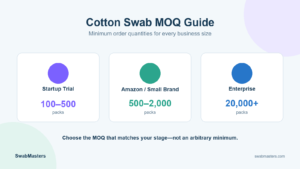
If order quantity is still uncertain, review the cotton swab MOQ guide before requesting prices.
A Practical Six-Step Sourcing Process
- Define the product. Prepare a one-page specification covering materials, dimensions, tip design, packaging, labeling and intended use.
- Shortlist supplier models. Compare one Vietnam manufacturer or distributor with at least one direct overseas OEM option.
- Verify the business. Check legal identity, factory status, certificate scope and export history.
- Approve samples. Test at least three production-representative samples and sign a golden sample.
- Lock the purchase order. Attach the specification, approved artwork, quality limits, inspection method and delivery terms.
- Inspect before shipment. Review quantity, workmanship, packaging, labels and documents before releasing the balance payment.
Need an OEM Cotton Swab Quote for Vietnam?
SwabMasters manufactures paper, bamboo, plastic, wooden, cosmetic and baby cotton swabs for private-label and wholesale buyers. Send us your target product, pack count, annual quantity and destination city. We can prepare samples, packaging options and an export quotation for comparison with your local supply route.
Frequently Asked Questions
Are cotton swabs manufactured in Vietnam?
Vietnam has domestic suppliers and production activity, but supplier listings may also represent importers, distributors or traders. Verify the actual factory, country of origin and production process for each quotation.
What is the HS code for cotton swabs imported into Vietnam?
Many standard cotton-wadding articles fall under HS heading 5601, with 5601.21 covering cotton wadding and articles thereof. The exact Vietnam tariff line depends on the finished product, intended use and any medication or saturation. Confirm the code with a licensed customs broker before shipping.
Is a Vietnam supplier always faster than importing from China?
A Vietnam supplier can be faster when it holds finished stock. A customized order may still depend on imported materials or overseas production. Compare confirmed production and delivery dates rather than assuming lead time from the supplier’s address.
What MOQ should a private-label buyer expect?
MOQ depends on the number of packaging designs, printing method, pack count, material and whether the supplier can combine production. Ask for separate MOQs for standard product, custom label and fully custom packaging.
Can SwabMasters ship cotton swabs to Vietnam?
Yes. SwabMasters can quote export orders for Vietnam subject to product specification, quantity, packaging and destination. The Vietnam importer remains responsible for confirming local classification, taxes, labeling and any product-specific registration.
Sources and Method Note
- World Bank WITS / UN Comtrade: HS 560121 exports to Vietnam, 2024.
- International Trade Administration: Vietnam labeling and marking requirements.
- International Trade Administration: Vietnam medical-device registration overview.
- Vietnam National Trade Repository: tariff commitment schedule.
Trade data is used as a sourcing-flow indicator, not as a claim about the exact cotton swab market size. Regulations, tariffs and product classifications can change. Buyers should verify current requirements with their Vietnam importer, customs broker and regulatory adviser before shipment.