
Are all cotton swabs the same? Not even close.
If you think a cotton swab is just a simple stick with cotton on the ends, you might be surprised. The world of cotton swabs is vast and highly specialized.
Choosing the wrong type of cotton swab can lead to poor performance, safety risks, or environmental harm. Whether you are a consumer looking for the best eco-friendly option, or a business buyer sourcing medical-grade supplies, knowing the different types of cotton swabs is crucial.
As a leading manufacturer with 26 years of experience since 2000, SwabMasters has produced billions of cotton swabs for global brands like MINISO and Sam’s Club. We know exactly what goes into making the perfect swab.
In this comprehensive guide, we will break down the different types of cotton swabs by stick material, tip shape, and industry use. We will also take you behind the scenes to show you how high-quality cotton swabs are manufactured.
Let’s dive in.
What Are the Different Types of Cotton Swabs by Stick Material?
When categorizing the different types of cotton swabs, the stick material is the most important factor. The material determines the swab’s flexibility, strength, and environmental impact.
At SwabMasters, we manufacture cotton swabs using four primary materials: bamboo, paper, plastic, and wood. Each material serves a specific purpose and caters to different user needs.
Here is a quick comparison of the different cotton swab materials:
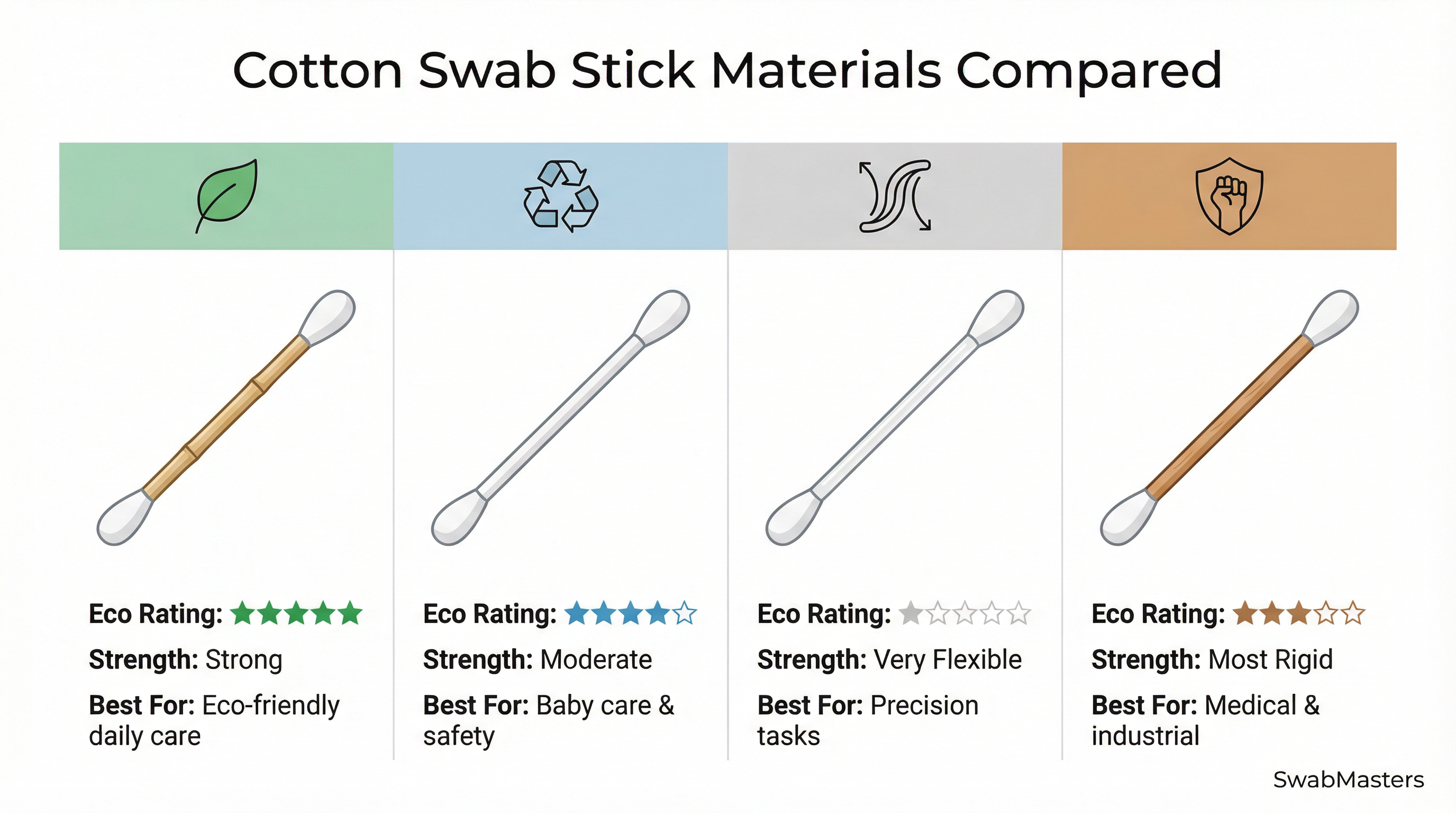
| Stick Material | Eco-Friendly Rating | Flexibility & Strength | Best Use Cases |
| Bamboo | Very High (100% Biodegradable) | Sturdy, hard to break | Eco-friendly alternative, daily care, makeup |
| Paper | High (Biodegradable) | Moderate (Softens in water) | Baby care, gentle daily cleaning |
| Plastic | Low (Non-biodegradable) | Very High (Flexible, won’t snap) | Precision cleaning, tasks requiring bending |
| Wood | Medium (Biodegradable but uses timber) | Very High (Most rigid) | Medical, industrial, forensic sampling |
Bamboo Cotton Swabs (The Eco-Friendly Choice)
Bamboo cotton swabs are rapidly becoming the most popular choice for environmentally conscious consumers. They are 100% biodegradable and sustainable.
Unlike plastic, bamboo breaks down naturally without leaving harmful microplastics behind. Bamboo is also incredibly fast-growing, making it a highly renewable resource.
From a performance standpoint, bamboo sticks are sturdy and rigid. They do not bend easily, which provides excellent control during use. This makes them perfect for makeup application, nail polish correction, and general daily hygiene.
If your brand is looking to appeal to eco-conscious buyers, bamboo cotton swabs are the ultimate choice.
Paper Cotton Swabs (Biodegradable & Safe)
Paper cotton swabs offer a great balance between safety and environmental responsibility. The sticks are made from tightly rolled paper, which is fully biodegradable.
The defining characteristic of paper sticks is their safety profile. If a paper stick is bent too far, it simply folds rather than snapping into sharp pieces. Furthermore, if a paper swab is accidentally flushed down the toilet, it will eventually soften and break apart (though flushing is still not recommended).
Because they are gentle and yield under pressure, paper cotton swabs are the gold standard for baby care. They ensure that accidental sudden movements won’t result in a rigid stick causing injury.
Plastic Cotton Swabs (Flexible but Less Sustainable)
Plastic cotton swabs have been the industry standard for decades. They are made from extruded plastic tubes, offering unmatched flexibility.
The main advantage of plastic sticks is that they can bend significantly without breaking. This flexibility is highly valued in certain precision cleaning tasks, such as cleaning intricate electronics or detailing small mechanical parts.
However, the environmental impact of single-use plastic is a major concern. Plastic cotton swabs are a significant contributor to ocean pollution. As a result, many countries and regions have banned or restricted the sale of plastic cotton swabs.
While they still have niche industrial uses, the consumer market is rapidly shifting away from plastic.
Wooden Cotton Swabs (Sturdy for Industrial/Medical)
Wooden cotton swabs are the heavy-duty option in the swab world. They are typically made from birch or pine wood.
The primary benefit of a wooden stick is its extreme rigidity. It will not bend under pressure, allowing the user to apply significant force. This makes wooden swabs ideal for medical applications, such as wound cleaning or applying topical medications.
They are also widely used in industrial settings for scrubbing tough grime off machinery, and in forensic science for collecting DNA samples.
While wood is natural and biodegradable, it requires cutting down trees, making it slightly less sustainable than fast-growing bamboo.
Types of Cotton Swabs Based on Tip Shapes and Designs
The shape of the cotton tip is just as important as the stick material. Different tip shapes are engineered for specific tasks, ranging from broad cleaning to pinpoint precision.
Understanding these shapes will help you choose the right tool for the job.
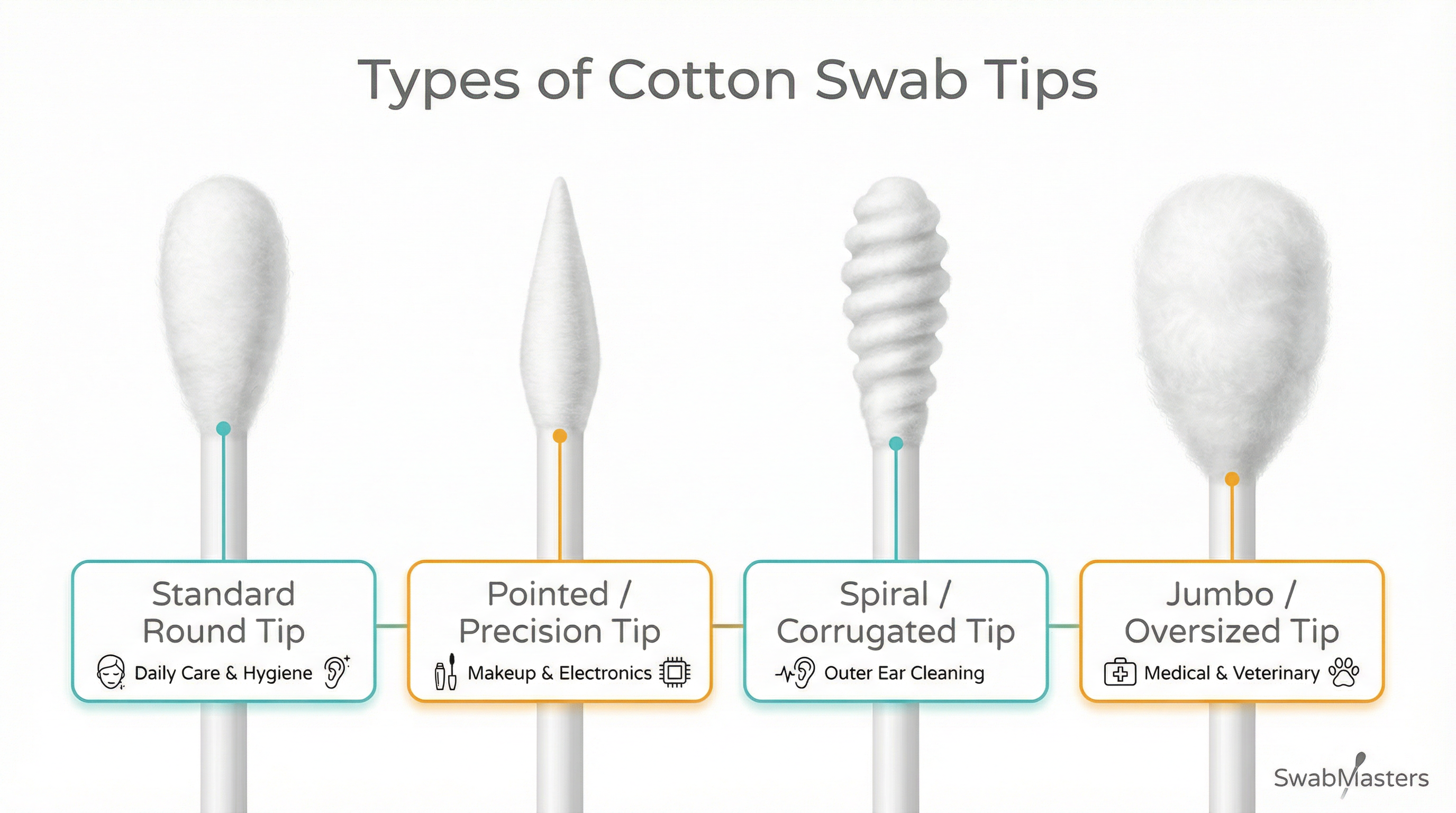
Standard Round Tips (Daily Care)
The standard round tip is the classic teardrop shape that most people are familiar with. It is the most versatile and widely used design.
This shape provides a good balance of surface area and softness. It is perfect for general daily hygiene, applying ointments, and basic cosmetic touch-ups.
At SwabMasters, our standard round tips are made from 100% pure, medical-grade cotton, ensuring maximum absorbency and a lint-free experience.
Pointed/Precision Tips (Makeup & Electronics)
Pointed cotton swabs, also known as precision tips, feature a sharply tapered end.
This design is a favorite among makeup artists. The sharp point allows for precise application or removal of eyeliner, lipstick, and nail polish. It acts like a tiny eraser for cosmetic mistakes.
Beyond beauty, pointed tips are excellent for cleaning tight crevices in electronics, such as keyboard keys, camera lenses, and smartphone charging ports.
Spiral/Corrugated Tips (Ear Cleaning)
Spiral cotton swabs have distinct grooves or ridges molded into the cotton tip.
These ridges act like tiny scoops, making them highly effective at grabbing and holding onto dirt and debris. They are commonly marketed for outer ear cleaning, as the corrugated surface catches wax better than a smooth round tip.
The spiral design also provides a gentle massaging sensation, which many users find comfortable.
Jumbo/Oversized Tips (Medical & Veterinary)
Jumbo cotton swabs feature an extra-large, highly absorbent cotton head.
These are rarely used for personal care. Instead, they are designed for medical, veterinary, and industrial applications. The large surface area is ideal for cleaning large wounds, applying generous amounts of antiseptic, or swabbing the throats of large animals.
The oversized tip ensures that a large area can be covered quickly and efficiently.
Specialized Types of Cotton Swabs for Various Industries
The cotton swab industry is not just about bathroom cabinets. It is a multi-billion dollar global market that serves highly specialized sectors.
As a manufacturer, SwabMasters produces custom cotton swabs for a wide range of industries, each with its own strict requirements.
Medical and Clinical Cotton Swabs
Medical cotton swabs are the most strictly regulated type of swab. They are used for wound care, applying medication, and collecting biological samples.
These swabs must be manufactured in a cleanroom environment and are often sterilized using ethylene oxide (EO) gas or gamma radiation. They are individually packaged to maintain sterility until the moment of use.
Furthermore, medical swabs must be FDA registered and comply with ISO 13485 standards. The cotton used must be 100% pure, medical-grade, and free from any fluorescent agents or impurities.
Cosmetic and Beauty Cotton Buds
Cosmetic cotton buds are designed specifically for the beauty industry. They are essential tools for makeup artists and daily beauty routines.
The most critical feature of a cosmetic swab is that it must be completely lint-free. When applying or removing makeup around the eyes, stray cotton fibers can cause severe irritation.
To achieve this, the cotton fibers are tightly wound and often treated with a specialized binder to prevent shedding. Pointed and standard round tips are the most common shapes in this category.
Industrial and Cleanroom Swabs
Industrial cotton swabs are built for heavy-duty cleaning and precision maintenance. They are used in electronics manufacturing, aerospace, and automotive industries.
These swabs are often used with harsh solvents like isopropyl alcohol (IPA). Therefore, the adhesive holding the cotton to the stick must be solvent-resistant.
In cleanroom environments, such as semiconductor manufacturing, swabs must have extremely low particle generation. Some industrial swabs are also designed to be anti-static (ESD-safe) to protect sensitive electronic components from electrostatic discharge.
Baby Care Cotton Swabs
Baby care cotton swabs are engineered with safety as the absolute top priority. They are used for cleaning a baby’s delicate outer ear, nose, and belly button.
The defining feature of a baby swab is its unique gourd or bell shape. The tip is narrow at the very end but quickly widens into a large, bulbous base. This physical barrier prevents the swab from being inserted too deeply into the ear canal, protecting the eardrum from injury.
Additionally, baby swabs almost exclusively use paper sticks, ensuring they will bend rather than snap if the baby moves suddenly.
Addressing Cotton Swab Safety: The Manufacturer’s Perspective
A common concern among consumers is the safety of using cotton swabs, particularly the risk of the cotton tip falling off or the stick breaking inside the ear.
As a manufacturer with over two decades of experience, SwabMasters takes these concerns very seriously. The safety of a cotton swab comes down to the quality of its manufacturing process.
First, it is crucial to follow medical advice: cotton swabs should never be inserted deep into the ear canal. They are designed for cleaning the outer ear only.
From a production standpoint, we ensure safety through rigorous quality control. The key to a safe swab lies in the precise application of water-soluble adhesive. We use high-precision molds to ensure the cotton fibers are tightly and securely wound around the stick.
According to our Quality Control Director at SwabMasters, “We precisely control the amount of glue used. Too little, and the tip might fall off; too much, and the tip becomes hard and uncomfortable. We also source premium, break-resistant bamboo and wood to eliminate the risk of splintering.”
By choosing a reputable manufacturer with ISO9001:2015 certification, you are choosing a product that has undergone strict safety testing.
How Are High-Quality Cotton Swabs Manufactured?
Have you ever wondered how millions of identical cotton swabs are produced every day? The manufacturing process is a fascinating blend of high-speed automation and strict quality control.
At SwabMasters, our production lines are fully automated to ensure consistency and hygiene.
The process begins with the selection of raw materials. We source premium, medical-grade cotton and high-quality sticks (bamboo, paper, plastic, or wood).
The sticks are fed into a high-speed machine. A precise drop of water-soluble adhesive is applied to both ends of the stick. Simultaneously, a continuous sliver of pure cotton is drawn into the machine.
The machine cuts the cotton to the exact required length and rapidly spins the stick, winding the cotton tightly around the glued ends. The shape of the mold determines whether the tip will be round, pointed, or spiral.
Finally, the finished swabs are automatically counted and packaged into boxes, bags, or blister packs in a dust-free cleanroom environment. Throughout the process, automated optical inspection systems check for any defects, ensuring only perfect swabs reach the consumer.
How to Choose the Right Types of Cotton Swabs for Your Brand?
If you are a brand owner, retailer, or distributor, choosing the right type of cotton swab is critical to your business success.
SwabMasters is your trusted partner for OEM and ODM cotton swab manufacturing. We offer a one-stop solution tailored to your specific market needs.
When selecting a swab for your brand, consider your target audience. Are they eco-conscious millennials? Bamboo or paper swabs are the way to go. Are you supplying medical clinics? You will need sterile, wooden-handled swabs.
We offer extensive customization options, including:
•Custom Tip Shapes: Round, pointed, spiral, or baby-safe gourd shapes.
•Stick Materials: Bamboo, paper, plastic, or wood.
•Packaging Design: Eco-friendly paper boxes, plastic tubs, or individual sterile wrappers with your brand logo.
•Flexible MOQ: We support low minimum order quantities for trial orders.
With our 26 years of experience and certifications like BSCI and WCA, you can trust SwabMasters to deliver premium quality at competitive prices.
Frequently Asked Questions (FAQs) About Cotton Swab Types
Are bamboo cotton swabs better than plastic?
Yes, bamboo cotton swabs are significantly better for the environment. They are 100% biodegradable and made from a highly renewable resource, whereas plastic swabs contribute to long-term plastic pollution in our oceans and landfills.
What type of cotton swab is best for cleaning electronics?
For cleaning electronics, pointed or precision-tip cotton swabs with wooden or plastic sticks are best. The pointed tip allows you to reach tight crevices, while the rigid stick provides control. Ensure the swab is lint-free to avoid leaving fibers behind.
Can I flush paper cotton swabs down the toilet?
No, you should never flush any type of cotton swab down the toilet, even if it has a paper stick. While paper will eventually break down, the cotton fibers can clump together and cause severe blockages in plumbing and sewage systems. Always dispose of them in the trash or compost bin.
What is the difference between medical cotton swabs and regular ones?
Medical cotton swabs are manufactured in strict cleanroom environments, use 100% pure medical-grade cotton, and are often sterilized and individually packaged. Regular consumer swabs are produced for general hygiene and do not meet the stringent FDA or ISO requirements for medical use.